完全入試ガイド

Classics at Cambridge — Admissions Guide 2027

Cambridgeへの当塾生徒の合格率

65%

Cambridgeの平均合格率

21%

CambridgeのClassicsは最も競争的な入試の一つ。Cambridge卒の専門講師による完全対策で合格を目指しましょう。

最終更新: 2026年5月

主要情報

  • A*AA典型オファー
  • 2:1志願者 / 定員
  • #1UK順位
  • 87定員(年)
  • Q800UCAS コード

概要

コース概要

Classics at the University of Cambridge is a BA (Hons) with 3-year (Q800) and 4-year (Q801) routes, a typical A-Level offer of A*AA, and an IB offer of 41–42 with 776 at HL. The course keeps Greek, Latin, and written argument central while opening advanced options across literature, history, philosophy, art, archaeology, and linguistics.

なぜCambridgeでClassicsを?

The academic reason to choose Cambridge is not just the ranking label; it is the structure of the course. The degree combines language work with literature, history, philosophy, art, archaeology, linguistics, and reception, then lets students specialise in Part II.

A university lecture hall from the back, students taking notes

Section 01

国際学生の出願

下のマップで自国をクリックすると、出願に必要な情報(受け入れられる資格、要求スコア、英語要件、現地の文脈)が表示されます。

International Applicants

Country-specific admissions requirements

CanadaUnited States of AmericaSouth KoreaIndiaChinaUnited KingdomMalaysiaJapan

Pick a highlighted country to see the admissions-test, score, and English-language requirements that apply for applicants from that country.

Section 02

出願要件

  • A-LevelA*AA
    Latin or Greek (3-year route), History, English Literature recommended.The minimum offer level is A*AA. Some Colleges may set higher offers or specify an A* in a particular subject. For the 3-year course, official guidance currently states Latin is required, while applicants offering Classical Greek instead of Latin should contact Colleges before applying. For the 4-year course, no specific subjects are required, but Classical Civilisation, English, History, and languages are recommended.
  • IB Diploma40–42 with 776 at HL
    HL: Latin at Higher Level for the 3-year course (Q800). Applicants with Classical Greek Higher Level instead of Latin should contact shortlisted College(s). required. For the 4-year course: Classical Civilisation or equivalent classical study where available, English, History, Languages (ancient or modern) recommended at HL.Some Colleges may make IB offers above the minimum offer level, including 777 or a higher points total, and may require 7 in particular subjects.
  • Advanced Placement (AP)Minimum of 5 AP Test scores at grade 5 in subjects related to the course, alongside a high SAT or ACT score and a high overall GPA in the US High School Diploma.
    AP Latin, if available and relevant to the applicant's route, Other AP subjects closely related to Classics, ancient history, literature, languages, or humanities, where available recommended. SAT/ACT: For all other courses at Cambridge outside the listed Science/Economics group: SAT minimum combined score of at least 1460 with Evidence-Based Reading and Writing at least 730, or ACT composite 32 out of 36, alongside APs or equivalent qualifications..For US applicants, a High School Diploma alone is not considered suitable preparation. Standardised tests should usually have been achieved within 2 years of matriculation, and applicants must disclose all AP, SAT, and ACT tests taken and scores achieved.
Admissions test
No pre-registered admissions test. Most colleges set a short at-interview translation, comprehension or commentary task — College admission assessment, no advance registration.
Written work
Submit two pieces of recent marked school work in a humanities subject — at least one in English. Standard deadline 10 November 2026.
Interview
Two college interviews. One discusses your submitted essays and personal-statement reading; the other is a pre-read interview where you commentate on an unseen passage (in Greek/Latin for the 3-year route, in English translation for the 4-year route).

Section 03

出願プロセスと重要日程

  1. Jun–Jul 2026

    Open days & shortlist colleges

    Visit Cambridge in person if you can. Open days run in late June and early July. Begin narrowing your college list and reading first-year reading lists.

  2. Sep 2026

    Draft your personal statement

    Write for the subject, not the institution. Cambridge admissions tutors look for ~80% academic content and genuine super-curricular engagement.

  3. 28 Sep 2026

    ESAT / TMUA registration deadline

    Pre-registration via the Pearson VUE admissions testing portal closes at 18:00 UK time. Late entry is not normally possible.

  4. 15 Oct 2026

    UCAS deadline

    Submit your UCAS application by 18:00 UK time on 15 October 2026.

  5. 12–16 Oct 2026

    Sit ESAT / TMUA

    ESAT and TMUA are sat in this window at Pearson VUE centres. LNAT and UCAT use their own test windows — check each test's site for booking dates.

  6. 22 Oct 2026

    My Cambridge Application deadline

    Complete the My Cambridge Application supplementary questionnaire by 18:00 UK time on 22 October 2026. This replaced the old SAQ.

  7. 10 Nov 2026

    Submitted written work deadline

    Most arts and humanities courses ask for one or two pieces of marked school work. Each college confirms its exact deadline; 10 November is the standard date.

  8. Dec 2026

    Interviews

    Around three-quarters of applicants are interviewed. Typically 1–2 interviews of 25–45 minutes each at your chosen or allocated college.

  9. 27 Jan 2027

    Main decisions released

    Cambridge releases its main decisions on 27 January 2027. Around a quarter of offers are made through the Winter Pool — strong applicants reconsidered by colleges with remaining places.

Section 04

入試テスト

Student working through problems at a desk with timed papers

Classics(University of Cambridge)の2027年度入試では、出願者に書面の入試テストは課されません。出願は推薦書・成績・パーソナルステートメント・提出物・面接で評価されます。

Always verify on the official Oxford admissions tests page.

Section 05

面接:当日の流れと対策

Invitation → Decision: the interview timeline

Interview Invitation

Late Nov

Arrival to Interview

Early Dec

Technical Question

Mid Dec

Decision

Early Jan

Question Types You’ll See

Translation or commentary on an unseen passageDiscussion of your submitted essaysArgument about ancient history or literature

Cambridge Classics interviews are academic discussions, with the exact arrangements confirmed by the College. The format may be online or in person depending on College arrangements.

The interview can test understanding of classical subjects, texts, languages, artefacts, historical contexts, academic potential, critical thinking, curiosity, and motivation for Classics. It may involve discussion of a passage, artefact, image, inscription, short source, language issue, submitted written work, or comparative theme.

Prepare by explaining your reasoning out loud. In reality, the useful habit is not producing perfect first answers; it is showing how you respond when a tutor presses your interpretation.

無料のClassics面接練習問題バンクで本番さながらの問題を練習しましょう。

無料練習問題
Two people in academic discussion across a table

Section 06

合否決定のしくみ

Cambridge Classics decisions are made holistically by Colleges, using the full application rather than a published formula.

That distinction matters: no applicant should treat the visual as a score sheet.

In practice, Cambridge is trying to judge whether you can thrive in a supervision-style environment. Every part of the application should point in the same direction: strong academic preparation, specific intellectual curiosity, and evidence that you can work with difficult material.

Our recommendation · weighting of admission factors

010203040500%
Interview
0%
Predicted grades
0%
Personal statement
0%
Submitted written work
0%
Contextual factors
% of decisionFactor

Oxbridge Mentors recommendation, drawn from observed offer patterns. University of Cambridge does not publish official weightings — exact balance varies by college, course and year.

Section 07

Personal Statement のコツ

Handwritten notes and a laptop open to a draft document

A strong Classics personal statement should not read like a museum itinerary or a book list. Use two or three academic problems and show how your thinking developed.

For the 3-year route, language work should appear as evidence of precision, not just as a qualification. For the 4-year route, it helps to show language readiness through beginner Latin or Greek practice, close work with translation, or reflection on how translation changes meaning.

Because Cambridge interviews and written-work discussion can press you on argument, evidence, and revision, the statement should give tutors something specific to test in conversation. A better paragraph might compare two versions of a myth, analyse a speech in translation, or question how an object changes the historical story told by a text.

専門家による一行一行の解説付き完全例文を見る。

Classics PS例文

Section 08

プロジェクト

  1. 01正当性
  2. 02プロジェクト概要
  3. 03実施内容
  4. 04困難
  5. 05解決策
  6. 06振り返り

Projects work best when they give you something precise to discuss in a supervision-style interview or in relation to submitted written work. Choose one narrow question, collect evidence, and write a short reflection on what changed as you read.

  • Classical language starter dossier: Choose either Latin or Ancient Greek and build a short dossier of grammar notes, vocabulary, translation attempts and reflections on how meaning changes between the original language and English translation.
  • Reception study of one ancient figure: Track a figure such as Medea, Odysseus, Antigone, Dido or Augustus across an ancient source and one later adaptation, asking what each version changes and why.
  • Object-led ancient history investigation: Select one coin, vase, inscription, sculpture or domestic object from a museum collection and use it to frame a historical question about power, gender, religion, trade or identity.
Open books, a notebook, and a coffee on a wooden desk

Section 08

その他のサプリキュラム

Other supercurriculars should support the academic argument of your application. They are useful when they lead to notes, questions, short essays, or further reading.

These are support, not substitute. Reflection matters more than volume.

  • Primary texts in translation:

    Read short sections carefully rather than racing through long lists. Keep a log of questions about narrative voice, genre, politics, religion and reception.

  • Latin or Greek practice:

    Applicants targeting the 3-year route should strengthen Latin or Greek accuracy. Applicants targeting the 4-year route can still show language readiness through beginner practice.

  • Ancient history and archaeology:

    Use timelines, maps and material evidence to connect literary texts with the societies that produced and transmitted them.

  • Museum and collection work:

    Analyse museum labels critically: ask what evidence the label uses, what remains uncertain, and how the object might be interpreted differently.

  • Essay-writing practice:

    Write short analytical essays that make a clear claim, use precise evidence and consider alternative interpretations.

  • Lectures, podcasts and public scholarship:

    Use talks and podcasts to discover debates, but convert passive listening into notes, questions and further reading.

Section 08

コンペティション

Competitions are not required for Cambridge Classics. What they do well is stretch your research, planning, and argumentative writing under a defined brief.

  1. Fitzwilliam College Ancient World and Classics Competition — tests independent research, close reading, argument and interest in the ancient world. Prepare by: Choose a question that genuinely interests you, define a narrow argument, and use both primary evidence and accessible secondary scholarship.
  2. St John's College Oxford Classics and Ancient History Essay Competition — tests essay structure, historical reasoning, classical knowledge and the ability to sustain a concise argument. Prepare by: Read around the question, plan before drafting, and make sure every paragraph directly advances the argument.
  3. Mary Renault Prize, St Hugh's College Oxford — tests classical reception, literary interpretation and engagement with the ancient world through later culture. Prepare by: Compare an ancient source with a later response and focus on how adaptation changes meaning for a new audience.
  4. John Locke Institute Global Essay Prize — tests philosophical, historical or political argument, depending on category, with emphasis on independent thought. Prepare by: Pick a category that connects naturally to your Classics interests, define key terms and avoid broad survey answers.
  5. Trinity College Cambridge Essay Prizes — tests advanced humanities writing, source handling and analytical clarity across relevant prize categories. Prepare by: Select the most relevant prize category, study winning-style academic essays, and practise building a focused thesis from evidence.

None are required; one or two done well beats five half-attempted.

Section 09

コース内容

  1. Year

    01 / 04

    1

    Preliminary Year (4-year route only)

    Latin foundations and introduction to Greek

    This access year is for students on the four-year route who have not studied Latin or Ancient Greek to A level. It builds a secure grounding in Latin, introduces Ancient Greek, and begins the study of non-literary classical topics so students can progress into Part IA.

    Designed to open the full Classics degree to students without A-level Latin or Ancient Greek.

  2. Year

    02 / 04

    2

    Part IA (Year 1 for 3-year route)

    Core languages and foundations across the ancient world

    Part IA extends knowledge of Greek and Latin and introduces the main areas of classical enquiry. Students read original Greek and Latin texts while also studying ancient history, archaeology, art, philosophy, philology, linguistics, and the classical tradition.

    Language exams are adapted to reflect the student’s starting level and progress during the year.

  3. Year

    03 / 04

    3

    Part IB

    Choice begins within the Classical Tripos

    Part IB keeps Greek and Latin translation at the centre while allowing students to begin shaping their own academic path. Alongside compulsory translation papers, students choose from literature, philosophy, history, art and archaeology, and linguistics options.

    Compulsory translation keeps linguistic fluency central while optional papers open up subject choice.

  4. Year

    04 / 04

    4

    Part II

    Advanced specialisation and dissertation option

    Part II is the final-year advanced stage. Students may specialise in one discipline, such as archaeology, or build a broad portfolio across literature, philosophy, history, art and archaeology, linguistics, interdisciplinary studies, and papers from another degree course.

    The dissertation option allows a substantial independent project in a chosen Classics topic.

Section 10

提出書類

A bound essay on a tutor desk beside a fountain pen

Cambridge states that applicants for both the 3-year and 4-year Classics routes must submit 2 pieces of written work. The assessing College tells applicants what to submit, the deadline, and the submission method.

Choose work you can defend, revise, and explain rather than simply the piece with the highest mark.

Section 11

Classicsの知識を深める

For Roman history, start with SPQR: A History of Ancient Rome; for Greek epic and translation, use The Odyssey; for wider Greek context, add Ancient Greece: A Very Short Introduction and Introducing the Ancient Greeks. Virgil’s The Aeneid is useful if you want to connect literature, empire, and Augustan ideology.

For video and object work, use Classics at Cambridge, Getty Museum, The British Museum, and Center for Hellenic Studies. Pair one Cambridge-facing video with one museum-led object study, then write a paragraph on what the visual evidence adds that a literary text cannot.

For audio, In Our Time: History, Natalie Haynes Stands Up for the Classics,Let's Talk About Myths, Baby!give structured routes into ancient history, myth, reception, and interpretive debates. For language and text practice, use Getting started on classical Latin, JACT Greek Summer School, Perseus Digital Library, Dickinson College Commentaries.

A study planner, highlighters and a stack of revision cards

Section 12

カレッジ選択と再振り分け

29 colleges offer this subject. Not published of applicants submit an open application. ~19% of places come through the pool.

College choice determines which College handles the application, interviews, and offer decision.

Open applicants are treated the same as direct College applicants, and an open application is allocated to a College that has received fewer applications per place for that course.

If a College sees an applicant as strong but cannot make an offer itself, the applicant can be placed in the Winter Pool so other Colleges can consider them. Around 19% of October 2024 applications were placed in the Winter Pool.

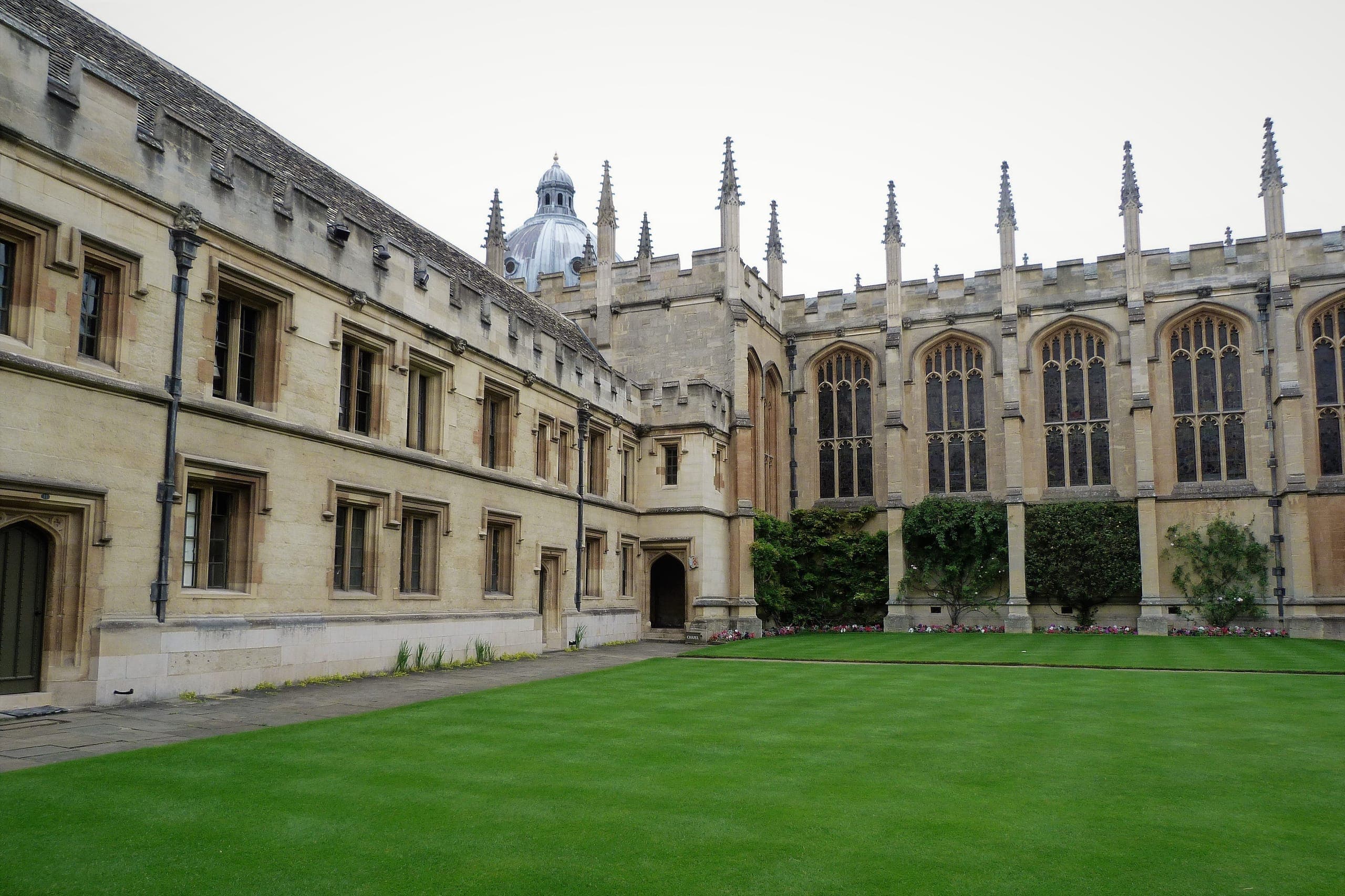
Stone college quadrangle viewed through an archway

Section 13

卒業後のキャリア

Cambridge Classics graduates enter a wide range of fields rather than a single vocational pathway.

The sector chart groups graduate outcomes broadly; because the 3-year and 4-year routes have small or suppressed cohorts in Discover Uni data, treat the chart as indicative rather than definitive. The practical message for applicants is that Classics is not a narrow vocational degree, but it also does not point to one automatic career track.

Section 14

特別な事情について

Cambridge says decisions are based on all available information considered together, with particular attention to recent and relevant academic performance. Applicants whose studies have been disrupted or disadvantaged can ask a teacher, doctor, social worker, or other relevant professional to notify Cambridge through the appropriate process.

Subject availability matters for Classics. The 4-year route is specifically designed for applicants with little or no Latin or Greek, while the 3-year route normally requires Latin and applicants with Greek rather than Latin should contact a College before applying.

Contextual data can help assess applications holistically, but Cambridge says flagged applicants will not necessarily be interviewed, made an offer, or made a lower conditional offer.

Watch & Learn

Cambridge Classics 参考動画

学生ブログ・模擬面接・講義体験・入試アドバイス。

Day in the life of a Cambridge Classics student

A student-facing introduction to what studying Classics at Cambridge can look like day to day.

Classics at Cambridge

A course-facing overview from Cambridge Classics that helps applicants understand the subject and environment.

Art Break: What People Wrote in the Late Bronze Age

A short object-and-writing focused video useful for connecting language, archaeology and ancient societies.

Explore Ancient Worlds Through Art: Elgin Throne

A museum-led exploration of ancient art that supports visual and material-culture analysis.

Portraying Power: Representations of Hellenistic Queens

A useful visual route into gender, rulership, image-making and Hellenistic political culture.

All videos are the property of their respective creators.

Further Reading

Recommended Resources

専門講師が推薦するSupercurricular読書リスト・ウェブサイト・ツール。

  • Cambridge Classics course page by University of Cambridge[Website]Primary source for entry requirements, course structure, written work and course-specific application details.
  • Cambridge admissions statistics by University of Cambridge[Website]Official applications, offers and acceptances data by course and cycle.
  • Cambridge interview guidance by University of Cambridge[Website]Primary guidance on how Cambridge interviews are arranged and what applicants should expect.
  • Cambridge written work guidance by University of Cambridge[Website]Practical guidance on written work submission, cover sheets and College instructions.
  • Perseus Digital Library by Tufts University[Website]A free digital library for Greek and Roman texts, translations and linguistic exploration.
  • Dickinson College Commentaries by Dickinson College[Website]Annotated ancient-language texts that support independent reading beyond school syllabuses.
  • SPQR: A History of Ancient Rome by Mary Beard[Book]A strong starting point for applicants wanting to connect Roman history with evidence, myth and modern interpretation.
  • JACT Greek Summer School by Joint Association of Classical Teachers[Course]A rigorous summer option for students beginning or extending Ancient Greek.

よくあるご質問

Yes, the 4-year Classics course is designed for applicants with little or no Latin or Greek. The 3-year course normally requires Latin, and applicants who have Greek rather than Latin should contact a College before applying.
Cambridge currently lists Q800 for the 3-year Classics route and Q801 for the 4-year route.
Cambridge currently requires 2 pieces of written work for both the 3-year and 4-year Classics routes. The College assessing the application will give submission instructions and deadlines.
Cambridge lists a College admission assessment for both Classics routes. It is arranged by the assessing College if you are shortlisted for interview, and you do not need to register for it in advance.
The standard Cambridge Classics offer is A*AA at A Level or 41-42 points in the IB with 776 at Higher Level. Subject requirements differ by route: the 3-year route normally requires Latin, while the 4-year route has no specific subject requirement.
Using the official 2024 statistics and combining Classics with Classics (4 years), there were 194 applications, 121 offers and 87 acceptances, giving approximately 2.2 applicants per acceptance.
Choose a College based on academic fit, accommodation, location, atmosphere and practical preferences rather than trying to predict admissions odds. Cambridge open applicants are allocated to a College with fewer applications per place for that course and are treated the same as direct College applicants.
It should show close engagement with ancient texts, languages, history, philosophy, art or archaeology; explain what questions interest you; and demonstrate that you can reflect critically on evidence rather than simply listing books or experiences.

Classics(Cambridge)出願の専門サポート

専門講師との無料30分相談をご予約ください。

無料相談を予約する