完全入試ガイド

Asian and Middle Eastern Studies at University of Oxford

Oxfordへの当塾生徒の合格率

65%

Oxfordの平均合格率

17%

Asian and Middle Eastern Studies(University of Oxford)出願に必要なすべて:出願要件・面接・典型オファーとOxford卒業生によるインサイダーアドバイス。

最終更新: 2026年5月

主要情報

  • AAA典型オファー
  • 3:1志願者 / 定員
  • #2026UK順位
  • 36定員(年)
  • T601UCAS コード

概要

コース概要

Asian and Middle Eastern Studies at Oxford is a BA in intensive language and regional study, with a typical offer of AAA and no written admissions test. The course lasts 3 or 4 years depending on option, and modern-language routes usually include a year abroad; applicants submit two pieces of written work in English by 10 November 2026.

なぜOxfordでAsian and Middle Eastern Studiesを?

Oxford's course page verifies the course as Asian and Middle Eastern Studies, delivered through several named options rather than one generic pathway. The course page reports these 2023–25 three-year average admissions figures: intake of 36 students, interviewed rate of 85% and successful rate of 32%.

A university lecture hall from the back, students taking notes

Section 01

国際学生の出願

下のマップで自国をクリックすると、出願に必要な情報(受け入れられる資格、要求スコア、英語要件、現地の文脈)が表示されます。

International Applicants

Country-specific admissions requirements

FijiTanzaniaW. SaharaCanadaUnited States of AmericaKazakhstanUzbekistanPapua New GuineaIndonesiaArgentinaChileDem. Rep. CongoSomaliaKenyaSudanChadHaitiDominican Rep.RussiaBahamasFalkland Is.NorwayGreenlandFr. S. Antarctic LandsTimor-LesteSouth AfricaLesothoMexicoUruguayBrazilBoliviaPeruColombiaPanamaCosta RicaNicaraguaHondurasEl SalvadorGuatemalaBelizeVenezuelaGuyanaSurinameFranceEcuadorPuerto RicoJamaicaCubaZimbabweBotswanaNamibiaSenegalMaliMauritaniaBeninNigerNigeriaCameroonTogoGhanaCôte d'IvoireGuineaGuinea-BissauLiberiaSierra LeoneBurkina FasoCentral African Rep.CongoGabonEq. GuineaZambiaMalawiMozambiqueeSwatiniAngolaBurundiIsraelLebanonMadagascarPalestineGambiaTunisiaAlgeriaJordanUnited Arab EmiratesQatarKuwaitIraqOmanVanuatuCambodiaThailandLaosMyanmarVietnamNorth KoreaSouth KoreaMongoliaIndiaBangladeshBhutanNepalPakistanAfghanistanTajikistanKyrgyzstanTurkmenistanIranSyriaArmeniaSwedenBelarusUkrainePolandAustriaHungaryMoldovaRomaniaLithuaniaLatviaEstoniaGermanyBulgariaGreeceTurkeyAlbaniaCroatiaSwitzerlandLuxembourgBelgiumNetherlandsPortugalSpainIrelandNew CaledoniaSolomon Is.New ZealandAustraliaSri LankaChinaTaiwanItalyDenmarkUnited KingdomIcelandAzerbaijanGeorgiaPhilippinesMalaysiaBruneiSloveniaFinlandSlovakiaCzechiaEritreaJapanParaguayYemenSaudi ArabiaAntarcticaN. CyprusCyprusMoroccoEgyptLibyaEthiopiaDjiboutiSomalilandUgandaRwandaBosnia and Herz.MacedoniaSerbiaMontenegroKosovoTrinidad and TobagoS. Sudan

Pick a highlighted country to see the admissions-test, score, and English-language requirements that apply for applicants from that country.

Section 02

出願要件

  • A-LevelAAA; no required subjects. A language can be helpful but is not required.
  • IB Diploma39 points including core points, with 666 at Higher Level; no required subjects. A Higher Level language can be helpful but is not required.
  • Advanced Placement (AP)Either four APs at grade 5, or three APs at grade 5 plus ACT 31+ or SAT 1460+, including any subjects required for the course.
Admissions test
No pre-registered admissions test for 2027 entry. Oxford retired the legacy written test for this course family — applicants are assessed on UCAS application, predicted grades, personal statement and interview alone.
Written work
Submit one or two pieces of recent marked school work in the subject (or a closely related humanities subject), normally with the teacher's comments visible. Standard Oxford written-work deadline is 10 November 2026 — each course's admissions page confirms the exact rules.
Interview
Two college interviews of around 25 minutes each. Subject-specific discussion or problem-solving interviews typical of Oxford tutorial teaching. Most interviews are in person at the college; many colleges still offer online interviews for international applicants.

Section 03

出願プロセスと重要日程

YEAR 12

Build subject evidence early

Explore the region, language, history, literature, religion or politics that draws you to Asian and Middle Eastern Studies. Keep notes on what you read or watch so your personal statement and interview preparation show sustained curiosity rather than a last-minute interest.

MAY — SEP

Start the UCAS application

UCAS applications for 2027 entry open in May 2026 and completed undergraduate applications can be submitted from 1 September 2026. Use this period to finalise course options, college preference or open application, reference arrangements and personal statement evidence.

15 OCT

Submit UCAS by 6pm UK time

Oxford applications for 2027 entry must be submitted through UCAS by 18:00 UK time on 15 October 2026. Asian and Middle Eastern Studies does not require a written admissions test, so this is the main application deadline.

10 NOV

Submit written work

Applicants must submit two pieces of written work in English for Asian and Middle Eastern Studies by 10 November 2026. Oxford says the topic and subject are less important than showing how you construct an argument and express ideas in English.

MID NOV — EARLY DEC

Watch for shortlisting emails

Oxford usually sends interview invitations or rejections between mid-November and early December, depending on the subject timetable. You may receive only about a week’s notice before an interview.

9 — 16 DEC

Attend online interviews

For 2027 entry, Asian and Middle Eastern Studies departmental interviews are scheduled for 9–10 December 2026 and first-college interviews for 10–12 December 2026, with possible additional interviews from 11–16 December. Interviews are online and tutorial-style academic discussions.

12 JAN

Receive Oxford decision

Interviewed applicants for 2027 entry are due to hear whether they have been offered a place on 12 January 2027. Conditional offers will still depend on meeting qualification requirements.

MAY — JUN

Reply to offers

UCAS reply deadlines depend on when all your universities have replied. Use the exact deadline shown in UCAS Hub rather than assuming a single universal date.

AUG — OCT

Confirm results and use Clearing if needed

Conditional Oxford offer-holders are confirmed after the university receives qualification results in mid-August. UCAS Clearing for 2027 entry opens on 2 July 2027 and the final date to add a Clearing choice is 18 October 2027.

Section 04

入試テスト

Student working through problems at a desk with timed papers

Asian and Middle Eastern Studies(University of Oxford)の2027年度入試では、出願者に書面の入試テストは課されません。出願は推薦書・成績・パーソナルステートメント・提出物・面接で評価されます。

Always verify on the official Oxford admissions tests page.

Section 05

面接:当日の流れと対策

Invitation → Decision: the interview timeline

Interview Invitation

Late Nov

Arrival to Interview

Early Dec

Technical Question

Mid Dec

Decision

Early Jan

Question Types You’ll See

Discussion of motivations for choosing a particular Asian or Middle Eastern language, region or civilisationFollow-up questions on the personal statement or submitted written workAnalysis of an unfamiliar text, source, image, object or argumentComparison of alternative interpretations of historical, literary, religious or cultural materialThinking-aloud questions designed to test how the applicant responds to new ideas rather than prior factual coverage

Shortlisted applicants are invited to online interviews in December, with AMES departmental interviews scheduled for 9–10 December 2026, first-college interviews for 10–12 December 2026 and possible additional interviews from 11–16 December 2026. Oxford's general guidance says candidates are likely to have more than one interview, and the AMES timetable separates departmental, first-college and possible additional interviews.

The useful preparation is not to script model answers. Practise explaining what draws you to a region, language or civilisation, then practise changing your view when given a new source, text, image or interpretation.

The Faculty selection criteria include intellectual curiosity, conceptual clarity, flexibility, accuracy and attention to detail, critical engagement, capacity for sustained work and enthusiasm. Your submitted written work may also become a springboard for interview discussion.

無料のAsian and Middle Eastern Studies面接練習問題バンクで本番さながらの問題を練習しましょう。

無料練習問題
Two people in academic discussion across a table

Section 06

合否決定のしくみ

There is no admissions test for Oxford Asian and Middle Eastern Studies, so decisions are built from the UCAS application, academic record and reference, two pieces of written work, and interview performance. The Faculty's published selection criteria include intellectual curiosity, clarity, flexibility, accuracy, critical engagement, capacity for sustained work and enthusiasm.

In reality, the absence of a written admissions test makes the written work and interview especially important in practice. We recommend treating both as evidence of how you think, not as separate hurdles to game.

Our recommendation · weighting of admission factors

0102030405041%
Interview
27%
Predicted grades
14%
Personal statement
11%
Submitted written work
7%
Contextual factors
% of decisionFactor

Oxbridge Mentors recommendation, drawn from observed offer patterns. University of Oxford does not publish official weightings — exact balance varies by college, course and year.

Section 07

Personal Statement のコツ

Handwritten notes and a laptop open to a draft document

A good AMES personal statement is usually built around a precise intellectual question. Instead of writing that you have always been interested in Japan, Arabic or the Silk Roads, show one argument, source, object, text or historical problem that changed how you think.

It helps to connect language learning with culture and evidence. For example, a paragraph on script, translation, ritual, empire, migration, manuscript culture or memory will usually be more useful than a broad paragraph saying that the region is important.

Because Oxford does not require prior study of an Asian or Middle Eastern language, your statement does not need to pretend that you are already advanced. Show readiness for sustained language work through regular practice, careful reflection on difficulty, and curiosity about how language shapes interpretation.

専門家による一行一行の解説付き完全例文を見る。

Asian and Middle Eastern Studies PS例文

Section 08

プロジェクト

  1. 01正当性
  2. 02プロジェクト概要
  3. 03実施内容
  4. 04困難
  5. 05解決策
  6. 06振り返り

A strong project gives tutors something concrete to discuss. It should show how you handle evidence, how you revise an interpretation, and how you move from description to argument.

Reflection matters more than scale. A 1,500-word object biography, a six-week language-learning log or a close comparison of two translations can be more useful than a long reading list with no argument.

  • Text-and-context close reading: Choose a translated poem, short story, religious text or historical document from an Asian or Middle Eastern tradition. Compare two translations or commentaries and write a short reflection on how language, context and interpretation change meaning.
  • Material culture micro-study: Use a museum object, manuscript image, coin, inscription, map or building as a starting point. Research provenance, historical setting, symbolism and contested interpretations, then produce a 1,500-word object biography.
  • Language-learning log: Spend six to eight weeks learning the script and basic grammar of a language relevant to a chosen AMES option. Keep a log of difficulties, patterns and cultural questions, then reflect on what language study revealed about the society being studied.
Open books, a notebook, and a coffee on a wooden desk

Section 08

その他のサプリキュラム

Use supercurricular work to test whether you enjoy the actual habits of the course: reading, language practice, source analysis, translation problems, object study and historical argument.

These activities support your application; they do not substitute for careful grades, written work and interview preparation.

  • Academic reading:

    Read introductory histories alongside one focused article or chapter. Admissions tutors value reflection on a specific argument more than long, undigested reading lists.

  • Museum and archive engagement:

    Use online collections from museums or libraries to investigate one object or manuscript. Practise moving from description to interpretation.

  • Language exposure:

    Try a short course in Arabic, Chinese, Japanese, Persian, Turkish, Hebrew, Sanskrit or another relevant language. Prior study is not required, but curiosity about language learning is central to AMES.

  • Lectures and online talks:

    Attend public lectures or watch faculty talks, then summarise one question you would ask the speaker.

  • Podcasts and documentaries:

    Use podcasts or documentaries to identify debates, but follow up with academic sources before citing them in a personal statement.

  • Essay competitions:

    Select a humanities essay question that requires argument, evidence and independent reading. Treat the process as practice for Oxford-style written work and interview discussion.

Section 08

コンペティション

Competitions are not required. What they do well is force you to define a question, handle evidence and write under a deadline.

  1. John Locke Institute Global Essay Prize — Independent thought, analytical structure, critical reasoning and persuasive academic writing across humanities and social-science categories. Prepare by: Choose a question connected to history, politics, theology, philosophy or international relations; build an argument from primary and secondary reading rather than relying on general opinion.
  2. Trinity College Cambridge Languages and Cultures Essay Prize — Language, culture, literature and comparative analysis suited to applicants interested in cultures beyond the Anglophone school curriculum. Prepare by: Use a focused case study from a language or cultural tradition and make the essay analytical rather than descriptive.
  3. Trinity College Cambridge Robson History Prize — Historical argument, source evaluation and independent research. Prepare by: Frame a precise historical question, evaluate competing interpretations and use evidence carefully.
  4. Fitzwilliam College Ancient World and Classics Essay Competition — Ancient-world analysis, textual or material evidence, and argument relevant to ancient Egypt, the Ancient Near East and broader ancient cultures. The URL is year-specific and should be checked annually. Prepare by: Select a question with scope for Asian, Middle Eastern or ancient Near Eastern evidence, and make the essay evidence-led.
  5. Fitzwilliam College Archaeology Essay Competition — Material culture, archaeological method, evidence interpretation and critical engagement with objects and landscapes. The URL is year-specific and should be checked annually. Prepare by: Use concrete examples from excavations, museums or landscapes, and show how archaeological evidence can support or challenge historical claims.

None are required; one or two done well beats five half-attempted.

Section 09

コース内容

  1. Year

    01 / 04

    1

    Language and regional foundations

    Foundations

    Students begin intensive work in their chosen Asian or Middle Eastern language alongside introductory study of the relevant history, culture, literature or religion. The exact mix varies by route: Arabic, Persian and Turkish combine elementary language with Islamic history and culture, while Chinese and Japanese combine language with regional history and culture, and ancient-language routes begin with survey and text work.

    Intensive language acquisition from the start.

  2. Year

    02 / 04

    2

    Year abroad or second-stage route work

    Immersion or consolidation

    For Arabic, Chinese, Japanese, Persian and Turkish, the second year is normally spent on an approved course of language instruction in the relevant region. Students on routes without a compulsory year abroad continue intensive language and text work in Oxford, often adding a second language or a related subject such as Archaeology and Anthropology.

    Most modern-language routes include a compulsory year abroad.

  3. Year

    03 / 04

    3

    Advanced language, texts and options or final year for three-year routes

    Advanced study

    Students return to Oxford, or continue a three-year route, with more advanced language, textual, historical and literary study. Depending on the option, they may take specialised papers in fields such as history, literature, religion, philosophy, politics, society, art, archaeology, cinema, or a subsidiary language. For three-year routes such as Assyriology, Egyptology and Sanskrit, this is the final year.

    Students combine advanced language work with regional specialisation.

  4. Year

    04 / 04

    4

    Specialisation, dissertation and Finals for four-year routes

    Final Honours

    Four-year route students complete advanced language and subject papers and write a dissertation or extended essay where required. Finals vary by option, but commonly include an oral examination, written papers and a compulsory dissertation on the modern-language routes.

    The dissertation gives students scope for independent research.

Section 10

提出書類

A bound essay on a tutor desk beside a fountain pen

Asian and Middle Eastern Studies requires two pieces of written work in English. The deadline for 2027 entry is 10 November 2026.

Oxford says the topic and school subject are not important; the purpose is to show how you construct an argument and express ideas in English. If you lack recent marked English work, Oxford allows a separate English essay on a topic being studied, normally with teacher guidance on the title.

We recommend choosing pieces that you can discuss calmly under follow-up questions. Tutors may use written work as a springboard for interview discussion, so reread your argument, evidence and weak points before December.

Section 11

Asian and Middle Eastern Studiesの知識を深める

For broad framing, start with Orientalism by Edward W. Pair it with The Silk Roads: A New History of the World by Peter Frankopan or The Silk Road: A New History by Valerie Hansen if you want a trans-Asian route into trade, movement and cultural exchange.

For regional foundations, A History of East Asia: From the Origins of Civilization to the Twenty-First Century by Charles Holcombe gives a long-view introduction to East Asia, while A History of the Modern Middle East by William L. Cleveland and Martin Bunton gives a clear survey of the modern Middle East. Do not try to cover every region; choose one route and build enough depth to ask better questions.

For video and object-led work, the Faculty of Asian and Middle Eastern Studies Oxford channel is the most directly relevant source for subject introductions and language tasters, while The British Museum is useful for curator-led work on objects and material evidence. For audio, In Our Time, Ottoman History Podcast and The China History Podcast give routes into history, religion, philosophy, the Ottoman world and Chinese history.

For language sampling, Getting started with Chinese 1 and Introduction to Arabic are beginner-friendly introductions to Chinese and Arabic, and Art of Asia can support visual analysis through Asian art and culture. Treat these as starting points for reflection, not as proof that you have mastered a language.

A study planner, highlighters and a stack of revision cards

Section 12

カレッジ選択と再振り分け

39 colleges offer this subject. ~20% of applicants submit an open application. ~33% of places come through the pool.

Applicants may express a college preference, but this does not guarantee consideration, interview or offer from that college.

Oxford uses reallocation to help ensure strong candidates are not disadvantaged by uneven college demand, and open applications are assigned to colleges or halls with relatively fewer applications for the course in that year. Around a fifth of applicants make an open application, and around a third of successful applicants receive an offer from a college they did not specify.

We recommend choosing a college for practical fit: location, accommodation, accessibility, size, facilities, funding and whether it offers your chosen AMES option.

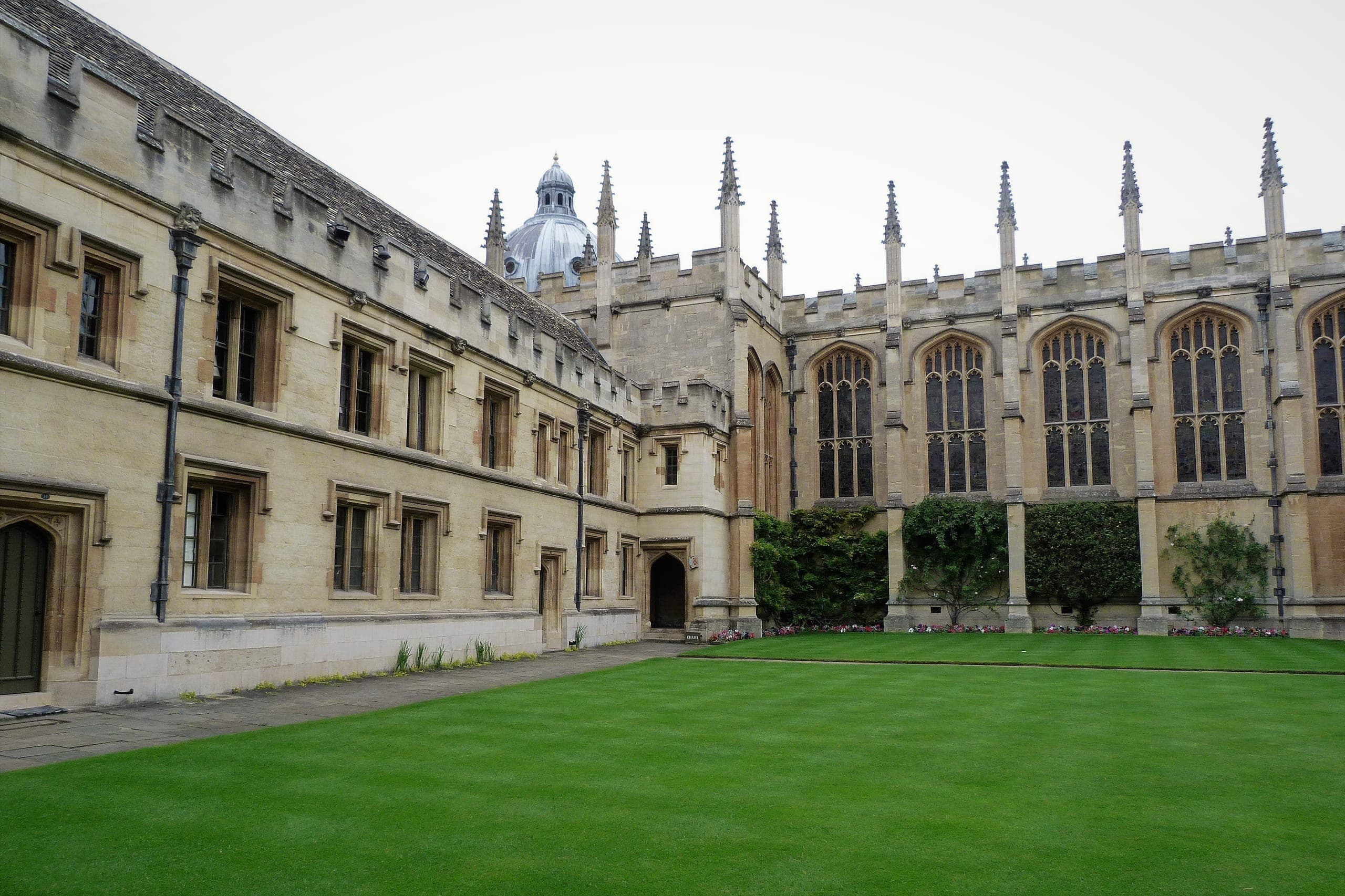
Stone college quadrangle viewed through an archway

Section 13

卒業後のキャリア

Oxford's course-page narrative describes AMES graduates as entering fields including finance, media, commerce, the Civil Service, law, accountancy, international development, education and the arts, and says around 30% continue to further study; that 30% figure was not independently re-verified in this audit. The quantitative sector chart should be labelled as a Discover Uni Languages/area-studies proxy rather than AMES-specific verified outcome data.

The practical message is that AMES is not training for one fixed job. It is a language, culture and evidence degree, so career preparation should include internships, writing samples, language progress and a clear explanation of the regional expertise you are building.

Section 14

特別な事情について

Oxford states that grades are considered in the context in which they were achieved. For AMES, Oxford lists no required or recommended school subjects, which matters because many UK and international schools do not offer Asian or Middle Eastern languages.

Applicants with disability or personal circumstances affecting handwriting should contact the Faculty if applying for Japanese, Chinese or Korean, because handwriting is identified as a mandatory core competence standard for those courses. Applicants whose schooling has limited recent marked English essays may still submit a separate English essay as written work, following Oxford's guidance.

Use the application to explain genuine educational constraint, not to apologise for ordinary subject choices. If your school did not offer a relevant language, make the evidence of curiosity visible through reading, writing and language sampling.

Watch & Learn

Oxford Asian and Middle Eastern Studies 参考動画

学生ブログ・模擬面接・講義体験・入試アドバイス。

Introduction | University of Oxford Faculty of Asian and Middle Eastern Studies

Faculty introduction to Asian and Middle Eastern Studies at Oxford.

Language Taster: Chinese | University of Oxford Faculty of Asian and Middle Eastern Studies

A short taster session for applicants curious about Chinese language learning.

Language Taster: Arabic | University of Oxford Faculty of Asian and Middle Eastern Studies

A short taster session for applicants curious about Arabic language learning.

Three Egyptologists | University of Oxford Faculty of Asian and Middle Eastern Studies

Faculty video introducing Egyptology through Oxford researchers.

Three Rare Uzbek Manuscripts | University of Oxford Faculty of Asian and Middle Eastern Studies

A manuscript-focused video useful for exploring material culture and textual evidence.

All videos are the property of their respective creators.

Further Reading

Recommended Resources

専門講師が推薦するSupercurricular読書リスト・ウェブサイト・ツール。

  • Oxford Asian and Middle Eastern Studies course page by University of Oxford[Website]Primary source for current entry requirements, written work, interview and course structure.
  • Faculty AMES videos by University of Oxford Faculty of Asian and Middle Eastern Studies[Website]Faculty-made introductions, language tasters, lectures and interview guidance.
  • Oxford Supercurricular Hub by University of Oxford[Website]Oxford's guidance on exploring, engaging with and reflecting on subject material.
  • Nizami Ganjavi Library by Bodleian Libraries, University of Oxford[Website]Oxford's main library for materials on the Middle East, North Africa, the Caucasus, South and Central Asia and Korea.
  • Khan Academy Art of Asia by Khan Academy[Course]Free structured material on Asian art and culture through themes, regions and objects.
  • British Museum by The British Museum[Website]Object-led exploration of world cultures, useful for material-culture projects.
  • Ottoman History Podcast by Ottoman History Podcast[Podcast]A large academic audio archive for Ottoman, Middle Eastern and connected histories.

よくあるご質問

No. Oxford states that applicants do not need to take a written admissions test for this course.
Two pieces written in English are required. They are intended to show how you construct an argument and express ideas in English, not to test a specific school subject.
The course page lists 10 November 2026 as the written-work submission deadline.
No. Oxford states that students are not expected to have studied an Asian or Middle Eastern language before. A language at A-level, IB Higher Level or equivalent can be helpful but is not required.
Yes. For 2027 entry, shortlisted applicants are invited to online interviews in December 2026.
The AMES Faculty lists selection criteria including intellectual curiosity, conceptual clarity, flexibility, accuracy and attention to detail, critical engagement, capacity for hard work and enthusiasm.
Oxford says tutors have no preference between direct and open applications, colleges do not specialise in subjects, and reallocation is used to balance applicant numbers. Choose a college for practical fit rather than perceived admissions advantage.
Students taking Arabic, Chinese, Japanese, Persian or Turkish normally take the second year abroad. Hebrew students can choose a year abroad, but it is not compulsory.

Asian and Middle Eastern Studies(Oxford)出願の専門サポート

専門講師との無料30分相談をご予約ください。

無料相談を予約する