完全入試ガイド

History (Ancient and Modern) at University of Oxford

Oxfordへの当塾生徒の合格率

65%

Oxfordの平均合格率

17%

History (Ancient and Modern)(University of Oxford)出願に必要なすべて:出願要件・面接・典型オファーとOxford卒業生によるインサイダーアドバイス。

最終更新: 2026年5月

主要情報

  • AAA典型オファー
  • 4:1志願者 / 定員
  • #2UK順位
  • 24定員(年)
  • V118UCAS コード

概要

コース概要

History (Ancient and Modern) at Oxford is a 3-year BA for 2027 entry with a typical offer of AAA and verified UCAS code V118. It combines ancient and later history, has no written admissions test, but requires submitted written work and online interviews for shortlisted applicants.

なぜOxfordでHistory (Ancient and Modern)を?

The main academic reason to choose this course is the ancient-modern range: Oxford defines it as a combined course spanning the Bronze Age Mediterranean, Greco-Roman history, late antiquity, medieval and early modern periods, and modern British, European and world history. The first year introduces Greek or Roman history, European or world history, and optional ancient-history, historiographical, text-based or language work.

A university lecture hall from the back, students taking notes

Section 01

国際学生の出願

下のマップで自国をクリックすると、出願に必要な情報(受け入れられる資格、要求スコア、英語要件、現地の文脈)が表示されます。

International Applicants

Country-specific admissions requirements

FijiTanzaniaW. SaharaCanadaUnited States of AmericaKazakhstanUzbekistanPapua New GuineaIndonesiaArgentinaChileDem. Rep. CongoSomaliaKenyaSudanChadHaitiDominican Rep.RussiaBahamasFalkland Is.NorwayGreenlandFr. S. Antarctic LandsTimor-LesteSouth AfricaLesothoMexicoUruguayBrazilBoliviaPeruColombiaPanamaCosta RicaNicaraguaHondurasEl SalvadorGuatemalaBelizeVenezuelaGuyanaSurinameFranceEcuadorPuerto RicoJamaicaCubaZimbabweBotswanaNamibiaSenegalMaliMauritaniaBeninNigerNigeriaCameroonTogoGhanaCôte d'IvoireGuineaGuinea-BissauLiberiaSierra LeoneBurkina FasoCentral African Rep.CongoGabonEq. GuineaZambiaMalawiMozambiqueeSwatiniAngolaBurundiIsraelLebanonMadagascarPalestineGambiaTunisiaAlgeriaJordanUnited Arab EmiratesQatarKuwaitIraqOmanVanuatuCambodiaThailandLaosMyanmarVietnamNorth KoreaSouth KoreaMongoliaIndiaBangladeshBhutanNepalPakistanAfghanistanTajikistanKyrgyzstanTurkmenistanIranSyriaArmeniaSwedenBelarusUkrainePolandAustriaHungaryMoldovaRomaniaLithuaniaLatviaEstoniaGermanyBulgariaGreeceTurkeyAlbaniaCroatiaSwitzerlandLuxembourgBelgiumNetherlandsPortugalSpainIrelandNew CaledoniaSolomon Is.New ZealandAustraliaSri LankaChinaTaiwanItalyDenmarkUnited KingdomIcelandAzerbaijanGeorgiaPhilippinesMalaysiaBruneiSloveniaFinlandSlovakiaCzechiaEritreaJapanParaguayYemenSaudi ArabiaAntarcticaN. CyprusCyprusMoroccoEgyptLibyaEthiopiaDjiboutiSomalilandUgandaRwandaBosnia and Herz.MacedoniaSerbiaMontenegroKosovoTrinidad and TobagoS. Sudan

Pick a highlighted country to see the admissions-test, score, and English-language requirements that apply for applicants from that country.

Section 02

出願要件

  • A-LevelAAA
    History recommended.
  • IB Diploma38 (including core points) with 666 at HL
  • Advanced Placement (AP)Either four APs at grade 5 (including any subjects required for the course) or three APs at grade 5 (including any subjects required for the course) plus ACT 31+ or SAT 1460+.
Admissions test
No pre-registered admissions test for 2027 entry. Oxford retired the legacy written test for this course family — applicants are assessed on UCAS application, predicted grades, personal statement and interview alone.
Interview
Two college interviews of around 25 minutes each. Subject-specific discussion or problem-solving interviews typical of Oxford tutorial teaching. Most interviews are in person at the college; many colleges still offer online interviews for international applicants.

Section 03

出願プロセスと重要日程

MAY — AUG 2026

Build the application foundation

Start preparing the UCAS form from May 2026: choose the course, decide whether to name a college or make an open application, draft the personal statement and organise the academic reference.

EARLY SEP — 15 OCT 2026

Submit UCAS

Applications can be submitted from early September. The final Oxford deadline is 6pm UK time on 15 October 2026.

OCT 2026

Confirm no admissions test is required

Oxford states that applicants for History (Ancient and Modern) do not need to take a written admissions test for this course.

10 NOV 2026

Submit written work

All applicants for History courses must submit an argument-driven historical essay, maximum 2000 words, with the required cover sheet to their college by 10 November 2026.

MID NOV — EARLY DEC 2026

Watch for shortlisting news

Applicants are normally told whether they have been invited to interview between mid-November and early December. Oxford warns that shortlisted candidates may receive only about a week’s notice.

EARLY — MID DEC 2026

Attend online interviews

Shortlisted applicants are invited to online interviews in December. For this joint course, the History Faculty says joint-school candidates normally have two interviews, one for each side of the course.

12 JAN 2027

Receive Oxford decision

Shortlisted candidates for 2027 entry are informed of the outcome via UCAS on 12 January 2027, with colleges following up directly later that day.

MAY — JUN 2027

Reply to offers

UCAS reply deadlines depend on when all your universities have made decisions. For 2027 entry, UCAS lists 5 May 2027 if all decisions arrive by 31 March, and 2 June 2027 if all decisions arrive by 12 May.

AUG 2027

Meet offer conditions

Conditional Oxford offers are normally confirmed after qualification results are received, provided all offer conditions are met by the relevant UCAS/Oxford deadline. The exact 2027 UK results-day date was not confirmed in the checked official sources.

Section 04

入試テスト

Student working through problems at a desk with timed papers

History (Ancient and Modern)(University of Oxford)の2027年度入試では、出願者に書面の入試テストは課されません。出願は推薦書・成績・パーソナルステートメント・提出物・面接で評価されます。

Always verify on the official Oxford admissions tests page.

Section 05

面接:当日の流れと対策

Invitation → Decision: the interview timeline

Interview Invitation

Late Nov

Arrival to Interview

Early Dec

Technical Question

Mid Dec

Decision

Early Jan

Question Types You’ll See

Discussion of the argument, terms and assumptions in the submitted historical essay.Comparison between the submitted written work and another historical example the applicant has studied.Interpretation of an unseen or pre-read short passage of historical writing.Questions about books, podcasts, museums, sites or other academic material mentioned in the personal statement.Broader historical-thinking prompts where tutors are interested in reasoning rather than one fixed answer.

The interview is an academic discussion based on historical thinking, submitted written work, the personal statement and possibly a short passage. Oxford lists the location as online for this course cycle.

Tutors are looking for intellectual curiosity, independent thinking, flexibility with unfamiliar ideas, reasoned use of historical knowledge and the ability to discuss submitted work critically. In practice, it helps to practise explaining why your argument is framed as it is, what evidence would weaken it, and how another historian might disagree.

Typical question types include discussion of your submitted essay, comparison with another historical example, interpretation of an unseen or pre-read passage, and questions about books, podcasts, museums or other material named in the personal statement. Preparation is strongest when it revisits every claim in your written work and personal statement, rather than memorising scripts.

無料のHistory (Ancient and Modern)面接練習問題バンクで本番さながらの問題を練習しましょう。

無料練習問題
Two people in academic discussion across a table

Section 06

合否決定のしくみ

The decision-criteria visual should use the History Faculty’s published Ancient and Modern History post-interview framework as the closest available evidence: contextualised GCSE score 50%, written work 10%, History interview 20% and Classics-side interview 20%.

This should be labelled as an evidence-informed model rather than a complete mechanical formula, because Oxford also states that tutors consider all aspects of the application, including interview performance, any required tests or written work, prior attainment and predicted grades, UCAS personal statement and academic reference.

There is no written admissions test for this course, so selection does not use a written admissions-test score. The submitted essay and interview should be treated as connected parts of the application, because both reward historical argument rather than factual recall alone.

Our recommendation · weighting of admission factors

0102030405046%
Interview
31%
Predicted grades
15%
Personal statement
8%
Contextual factors
% of decisionFactor

Oxbridge Mentors recommendation, drawn from observed offer patterns. University of Oxford does not publish official weightings — exact balance varies by college, course and year.

Section 07

Personal Statement のコツ

Handwritten notes and a laptop open to a draft document

A strong personal statement for this course should show how you think historically across ancient and later material. It helps to choose one or two debates and explain what changed your mind, rather than listing every empire, period or museum visit you have encountered.

Use the combined nature of the course. A paragraph comparing evidence for an ancient society with evidence for a later period is usually more persuasive than a generic paragraph saying you enjoy both ancient and modern history.

Do not over-claim expertise in Latin, Greek or ancient material if you have not studied it formally. Oxford states that Latin or Greek is not required and can be learned from scratch, so honest curiosity and careful method matter more than pretending to have a classical background.

In reality, your statement should give tutors useful material to question, not try to win the application on its own.

専門家による一行一行の解説付き完全例文を見る。

History (Ancient and Modern) PS例文

Section 08

プロジェクト

  1. 01正当性
  2. 02プロジェクト概要
  3. 03実施内容
  4. 04困難
  5. 05解決策
  6. 06振り返り

Projects work best when they produce an argument, not just a reading list. For History (Ancient and Modern), the strongest project shape is usually a tight question, a limited evidence base, and a short reflection on what the sources cannot prove.

Use projects to practise the kind of thinking that appears in written work and interview: comparison, causation, interpretation and source limitation. A 1,500-word project you can defend clearly is usually more useful than a sprawling survey.

  • Compare one ancient and one modern empire through a single theme — Choose a focused theme such as citizenship, taxation, slavery, migration, frontier control or public memory. Use one ancient case and one post-classical or modern case, and produce a short bibliographic essay that weighs similarities, differences and evidential limits.
  • Write a source-methods reflection on one historical controversy — Pick a debate such as the causes of the Peloponnesian War, the fall of the Western Roman Empire, the French Revolution, or decolonisation. Compare how two historians use evidence differently and identify where interpretation, source survival and ideology shape conclusions.
  • Build a museum-object microhistory — Select an artefact from a museum collection, trace its original context, later reception and modern ethical questions, and connect it to a wider historical process such as trade, conquest, religion, literacy or empire.
Open books, a notebook, and a coffee on a wooden desk

Section 08

その他のサプリキュラム

Other supercurriculars should deepen the same habits: reading critically, handling evidence, and turning interest into a precise historical question. Use them as preparation for discussion, not as a badge collection.

These activities support the application, but they do not substitute for academic reading, written argument and interview preparation.

  • Primary-source reading:

    Read short sections of Herodotus, Thucydides, Livy, Tacitus or translated inscriptions alongside modern commentary; practise asking what the source can and cannot prove.

  • Historiography journal:

    Keep notes on how different historians frame causation, agency, continuity and change. This is especially useful for personal statements and written-work discussion.

  • Public lectures and podcasts:

    Use lectures from Oxford, Gresham, Yale, HistoryExtra and BBC sources, but convert passive listening into active notes and follow-up reading.

  • Museum and archive visits:

    Visit local, national or digital collections and practise linking material culture to written evidence and wider historical questions.

  • Essay competitions:

    Use competitions as a framework for independent research, not as résumé padding. The best value comes from choosing a demanding question, revising an argument and reflecting on feedback.

  • Language foundations:

    Latin or Greek is not required for this course, but beginners' work in Latin, Greek or another relevant language can sharpen attention to translation, terminology and source context.

Section 08

コンペティション

Competitions are not required, but they can stretch your writing if you use them to build an argument, handle evidence and revise carefully. One or two done well is stronger than five half-attempted.

  1. Julia Wood History Essay Competition — Independent historical argument, source awareness, clarity of structure and sustained written analysis. Prepare by: Choose a topic narrow enough for a 2,000-word analytical essay, read at least two historians with contrasting interpretations, and build a thesis rather than a narrative survey.
  2. Mary Renault Classical Reception Essay Competition — Understanding of how classical texts, ideas or material culture are reinterpreted in later periods. Prepare by: Start with one classical source and one later reception example; explain both contexts before arguing how meaning changes between them.
  3. John Locke Institute Global Essay Prize — Independent thought, critical reasoning, persuasive structure and cross-disciplinary argument. Prepare by: Select a History or Humanities question, define your terms precisely, and avoid broad claims unless you can support them with concrete historical evidence.
  4. Robert Robson History Prize — Historical essay writing for Year 12 or Lower Sixth students, including argument, breadth and evidence handling. Prepare by: Review the current year's question list, map possible interpretations, then build a concise argument supported by examples rather than trying to cover every period.
  5. Rex Nettleford Essay Prize: Colonialism and its Legacies — Critical engagement with colonial history, legacy, power and historical memory. Prepare by: Use a specific case study, distinguish between primary evidence and later interpretation, and handle contested terms such as legacy, empire and decolonisation carefully.

Section 09

コース内容

  1. Year

    01 / 03

    1

    Preliminary Examination foundations

    Ancient and modern historical foundations

    Students take four introductory papers spanning Greek or Roman history, European/world history, an optional or set ancient-history paper, and either a text-based, historiographical, approaches-to-history or language paper. The year is designed to build chronological range, source awareness and essay-based historical argument before progression to the Final Honour School.

    No Latin or Greek qualification is required before entry; students may learn either language from scratch.

  2. Year

    02 / 03

    2

    Final Honour School options begin

    Breadth, sources and methods

    Years 2 and 3 are published by Oxford as a combined Final Honour School stage, with six courses selected across ancient and modern history. In year 2, students normally deepen their range through period papers, further or special subjects, primary-source work and methodological study, while tutorial teaching is supplemented by faculty classes.

    Oxford lists illustrative ancient options such as Athenian Democracy, the Achaemenid Empire and Hellenistic societies and cultures.

  3. Year

    03 / 03

    3

    Thesis and final examinations

    Independent research and Finals

    The final year completes the combined Years 2-3 course menu and centres on the thesis, giving students a substantial piece of independent historical research. Students finish their selected ancient and modern history papers and may also take an optional Greek or Latin language paper.

    The thesis is the main independent research highlight of the degree.

Section 10

History (Ancient and Modern)の知識を深める

Start with method as well as content: What Is History? is useful for the problem of historical facts, and The Historian's Craft gives a concise route into evidence, method and historical purpose. For the ancient side, SPQR: A History of Ancient Rome, The Histories, The Peloponnesian War and The World of Late Antiquity: AD 150-750 give different models of narrative, argument, transition and source handling.

For lecture-style breadth, Introduction to Ancient Greek History covers Greek history from the Bronze Age to the classical period, while Roman Architecture and Roman Art and Archaeology connect Roman history to urbanism, material culture and archaeology. To widen beyond Greece and Rome, Superpowers of the Ancient World: The Near East is a useful route into ancient Near Eastern cultures and interaction.

For listening and video, use In Our Time: History, The Ancients, HistoryExtra Podcast and The Rest Is History as starting points for follow-up reading rather than as substitutes for books. The University of Oxford, Oxford Academic, The British Museum and Gresham College channels help connect admissions expectations, academic authors, artefacts and public lectures.

Keeping a short historiography notebook is useful. After each book, lecture or podcast, write down the historian’s question, the evidence used, the argument made and one objection you would raise.

A study planner, highlighters and a stack of revision cards

Section 11

カレッジ選択と再振り分け

30 colleges offer this subject. around a fifth of applicants of applicants submit an open application. around a third of successful applicants receive an offer from a college they did not specify of places come through the pool.

Oxford applicants may name a college or make an open application. Open applications are assigned to a college or hall with relatively fewer applications for the course that year.

Oxford’s current wording says around a fifth of applicants make open applications, and around a third of successful applicants receive an offer from a college they did not specify. That makes college choice real, but not a tactical shortcut.

College choice can affect where the first application is allocated and where a student may live and receive tutorials, but applicants should prioritise whether the college offers History (Ancient and Modern), location, accommodation, atmosphere, accessibility and personal fit. Oxford states that colleges do not specialise in particular subject areas, all colleges use the same course admissions process under a Common Framework, and all undergraduates belong both to a college and to the relevant department or faculty.

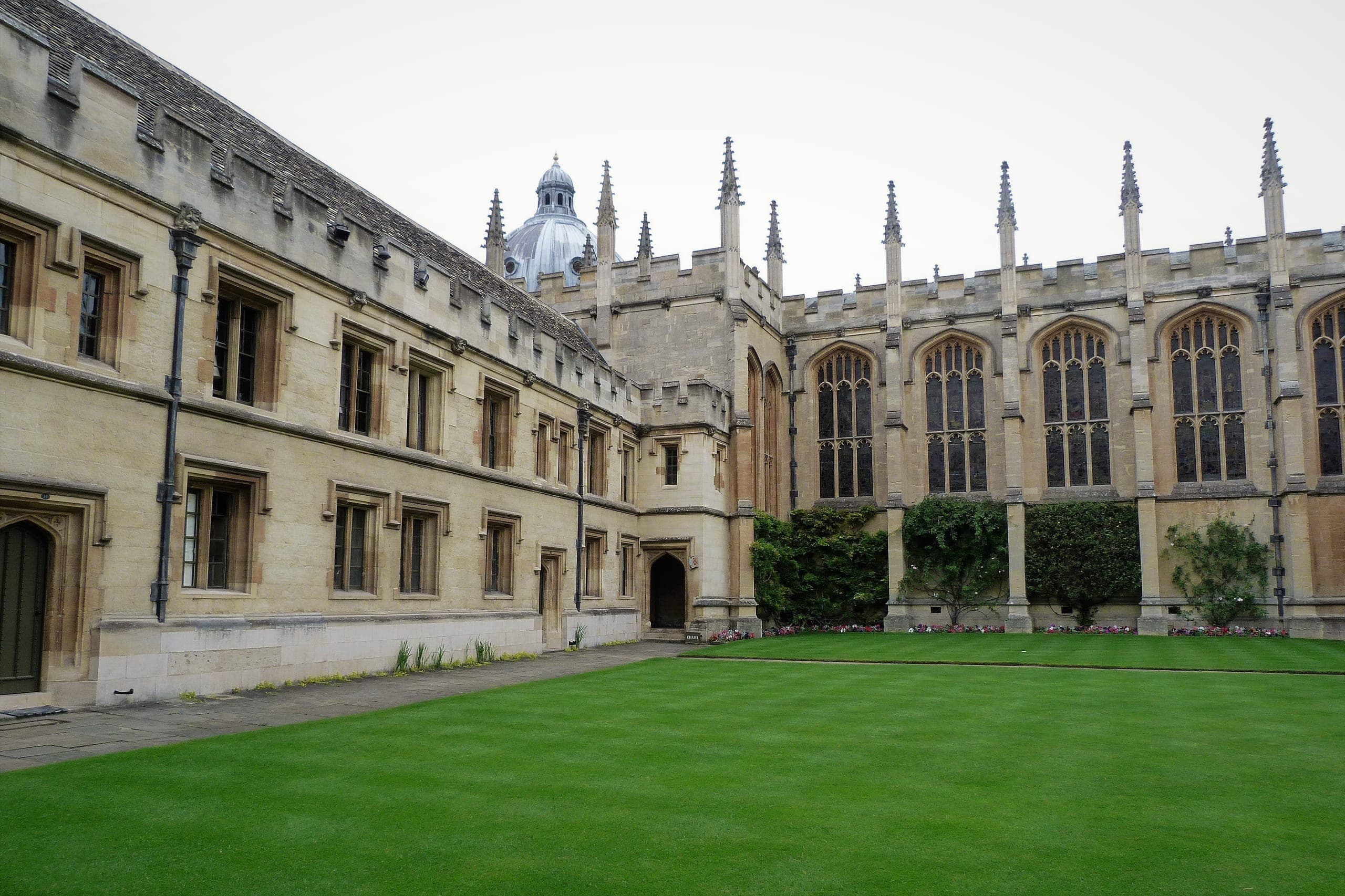
Stone college quadrangle viewed through an archway

Section 12

卒業後のキャリア

Oxford’s course page presents Ancient and Modern History as preparation for careers including law, teaching, investment banking, consultancy, advertising, accountancy, the Civil Service, publishing, journalism, media, global charity work, museums, librarianship and archive work.

The sector chart should be labelled as an Oxford-wide Graduate Outcomes Survey 2022 institutional benchmark, not a course-specific History (Ancient and Modern) destination split. In practice, the transferable skills are close reading, argument, evidence handling and written communication.

Section 13

特別な事情について

Oxford uses contextual data to understand achievement in context, including school performance, neighbourhood information, care experience, Free School Meals eligibility since age 11 and additional widening-participation information for UK applicants. The course page states that grades are considered in context wherever possible.

Oxford’s general contextual policy says applicants from the most disadvantaged backgrounds may be strongly recommended for shortlisting where evidence suggests they are likely to achieve the standard conditional offer and, where relevant, perform suitably in any required admissions test. For History (Ancient and Modern), the admissions-test part of that general formula is not applicable because the course has no written admissions test. GCSEs or IGCSEs are not required for all applicants, but where taken they can form part of academic assessment and are considered in context.

For History (Ancient and Modern), subject availability matters. If your school did not offer Classical Civilisation, Ancient History, Latin or Greek, that should not be treated as a defect, because the course does not require those subjects and allows language learning from scratch.

Watch & Learn

Oxford History (Ancient and Modern) 参考動画

学生ブログ・模擬面接・講義体験・入試アドバイス。

Classical Archaeology and Ancient History at Oxford University

Oxford course video introducing study of the ancient Mediterranean world.

History at Oxford University

Oxford undergraduate course video explaining the range and value of studying History.

Classics at Oxford University

Oxford course video introducing the breadth of Classics study and its interdisciplinary nature.

1. Introduction to Roman Architecture

Yale lecture introducing Roman urbanism, architecture and the built environment.

Alexander the Great | The Very Short Introductions Podcast

Oxford Academic episode introducing Alexander's legacy and historiographical problems.

All videos are the property of their respective creators.

Further Reading

Recommended Resources

専門講師が推薦するSupercurricular読書リスト・ウェブサイト・ツール。

よくあるご質問

No. Oxford's official course page says applicants do not need to take a written test for this course.
Yes. Applicants must submit one argument-driven essay on a historical topic, normally produced as part of school or college work, with a maximum length of 2,000 words. The course-page deadline is 10 November 2026.
No. Oxford states that applicants do not need a qualification in Latin or Greek and can learn either from scratch at Oxford if they wish.
No subject is formally required, but Oxford says History to A-level, Advanced Higher, IB Higher Level or equivalent is highly recommended. Classical language, Classical Civilisation and Ancient History can be helpful but are not required.
The standard offer is AAA at A-level, Advanced Highers AA/AAB, or IB 38 including core points with 666 at Higher Level, plus equivalent acceptable international qualifications.
Oxford's course page gives 3-year average 2023-25 figures of 71% interviewed, 23% successful and intake 24. Faculty of History 2024-25 data lists 111 applications and 31 offers for Ancient & Modern History.
Yes. Applicants may state a college preference or make an open application. Oxford says applicants may still be considered, interviewed or offered a place by a different college; around a third of successful applicants receive an offer from a college they did not specify.
Oxford describes interviews as academic conversations like a short tutorial. For this course, the course page says shortlisted applicants may discuss their submitted written work and personal statement, and may be asked to read and discuss a short passage.

History (Ancient and Modern)(Oxford)出願の専門サポート

専門講師との無料30分相談をご予約ください。

無料相談を予約する