完全入試ガイド

Geography at Cambridge — Admissions Guide 2027

Cambridgeへの当塾生徒の合格率

65%

Cambridgeの平均合格率

21%

CambridgeのGeographyは最も競争的な入試の一つ。Cambridge卒の専門講師による完全対策で合格を目指しましょう。

最終更新: 2026年5月

主要情報

  • A*AA典型オファー
  • 4:1志願者 / 定員
  • #3UK順位
  • 101定員(年)
  • L700UCAS コード

概要

コース概要

Geography at Cambridge is a 3-year BA (Hons) with UCAS code L700 and a typical A-Level offer of A*AA. It is a standalone course built around Parts IA, IB and II, with specialisation from Year 2 and a 10,000-word dissertation in the final year.

なぜCambridgeでGeographyを?

Cambridge's official course page displays Geography as #3 in the UK for the Complete University Guide 2026, while the audited Guardian 2026 table records Cambridge as #3 for Geography. The wider peer table is only partially verified: Guardian peer rows were checked, but full Complete University Guide peer rows and the Times/Sunday Times subject table were not independently accessible in full.

A university lecture hall from the back, students taking notes

Section 01

国際学生の出願

下のマップで自国をクリックすると、出願に必要な情報(受け入れられる資格、要求スコア、英語要件、現地の文脈)が表示されます。

International Applicants

Country-specific admissions requirements

CanadaUnited States of AmericaSouth KoreaIndiaChinaUnited KingdomMalaysiaJapan

Pick a highlighted country to see the admissions-test, score, and English-language requirements that apply for applicants from that country.

Section 02

出願要件

  • A-LevelA*AA
    Geography, A science, Mathematics recommended.Some Colleges usually make offers at the minimum level without specific subjects; Christ's, Churchill, Corpus Christi, Gonville & Caius, Lucy Cavendish and Selwyn are listed as requiring specific subjects and/or extra conditions, so applicants should check the relevant College page.
  • IB Diploma40–42 with 776 at HL
    Cambridge's general IB guidance states that some Colleges may ask for 777, a higher points total, or a 7 in particular subjects; check individual College requirements.
  • Advanced Placement (AP)check the official course page
    AP subjects particularly relevant to Geography recommended. SAT/ACT: Usually expected alongside APs: SAT minimum combined score of at least 1460 with Evidence-Based Reading and Writing at least 730, or ACT composite score 32 for non-Economics/non-Science courses..AP Tests usually need to have been taken within a two-year period, with the most recent test results achieved within two years of starting the course. Applicants must declare all tests and scores.
Admissions test
No pre-registered admissions test for 2027 entry. Some colleges set a short at-interview pre-read, map or data-analysis task — College admission assessment, no advance registration.
Interview
Two college interviews. Expect one rooted in your submitted work or personal-statement reading and one short pre-read or visual-prompt interview (a graph, map, or short article) discussed live.

Section 03

出願プロセスと重要日程

  1. Jun–Jul 2026

    Open days & shortlist colleges

    Visit Cambridge in person if you can. Open days run in late June and early July. Begin narrowing your college list and reading first-year reading lists.

  2. Sep 2026

    Draft your personal statement

    Write for the subject, not the institution. Cambridge admissions tutors look for ~80% academic content and genuine super-curricular engagement.

  3. 28 Sep 2026

    ESAT / TMUA registration deadline

    Pre-registration via the Pearson VUE admissions testing portal closes at 18:00 UK time. Late entry is not normally possible.

  4. 15 Oct 2026

    UCAS deadline

    Submit your UCAS application by 18:00 UK time on 15 October 2026.

  5. 12–16 Oct 2026

    Sit ESAT / TMUA

    ESAT and TMUA are sat in this window at Pearson VUE centres. LNAT and UCAT use their own test windows — check each test's site for booking dates.

  6. 22 Oct 2026

    My Cambridge Application deadline

    Complete the My Cambridge Application supplementary questionnaire by 18:00 UK time on 22 October 2026. This replaced the old SAQ.

  7. 10 Nov 2026

    Submitted written work deadline

    Most arts and humanities courses ask for one or two pieces of marked school work. Each college confirms its exact deadline; 10 November is the standard date.

  8. Dec 2026

    Interviews

    Around three-quarters of applicants are interviewed. Typically 1–2 interviews of 25–45 minutes each at your chosen or allocated college.

  9. 27 Jan 2027

    Main decisions released

    Cambridge releases its main decisions on 27 January 2027. Around a quarter of offers are made through the Winter Pool — strong applicants reconsidered by colleges with remaining places.

Section 04

入試テスト

Student working through problems at a desk with timed papers

Geography(University of Cambridge)の2027年度入試では、出願者に書面の入試テストは課されません。出願は推薦書・成績・パーソナルステートメント・提出物・面接で評価されます。

Always verify on the official Oxford admissions tests page.

Section 05

面接:当日の流れと対策

Invitation → Decision: the interview timeline

Interview Invitation

Late Nov

Arrival to Interview

Early Dec

Technical Question

Mid Dec

Decision

Early Jan

Question Types You’ll See

Description and interpretation of an unfamiliar map or graphDiscussion of a recent geographical news eventQuestions on your personal-statement reading

The interview is a subject-specific, supervision-style academic discussion.

In line with Cambridge's published interview guidance, the discussion may test understanding of geographical ideas and current issues, readiness for high-level study, critical and independent thinking, curiosity, openness to new ideas, enthusiasm and motivation. For Geography, that may mean discussing a current human or physical geography issue, unseen geographical data, a map, a short text, a visual source or a claim from your personal statement.

Practise thinking aloud through unfamiliar material: explain what you notice first, what evidence would change your view, and where scale or uncertainty matters.

無料のGeography面接練習問題バンクで本番さながらの問題を練習しましょう。

無料練習問題
Two people in academic discussion across a table

Section 06

合否決定のしくみ

Cambridge describes its admissions process as holistic: Colleges consider academic record, reference, personal statement, any requested submitted work or assessment, contextual information and interview performance together before making decisions.

Our recommendation · weighting of admission factors

010203040500%
Interview
0%
Predicted grades
0%
Personal statement
0%
Contextual factors
% of decisionFactor

Oxbridge Mentors recommendation, drawn from observed offer patterns. University of Cambridge does not publish official weightings — exact balance varies by college, course and year.

Section 07

Personal Statement のコツ

Handwritten notes and a laptop open to a draft document

A strong Geography personal statement should not read like a list of places visited. Choose 2 or 3 geographical problems and show how your reading, data work, field observation or school study changed your view.

Because Cambridge does not specify a university-wide required subject for Geography, the statement can help show subject preparation through related subjects, reading, local observation, fieldwork, data or independent projects.

It is worth balancing human and physical geography unless your application has a clear reason to lean one way. Reflection matters more than volume: one carefully analysed dataset or landscape can be stronger than five disconnected books.

専門家による一行一行の解説付き完全例文を見る。

Geography PS例文

Section 08

プロジェクト

  1. 01正当性
  2. 02プロジェクト概要
  3. 03実施内容
  4. 04困難
  5. 05解決策
  6. 06振り返り

Projects work best when they produce evidence: a map, a small dataset, a field notebook, a short essay, a GIS layer, a policy memo or a chart. Choose a question that can be investigated at more than one scale, then be ready to explain the method as well as the conclusion: for example, why a GIS layer was projected in a particular way, how rainfall data gaps affected a flood-risk claim, or what a land-use survey could not capture.

  • Neighbourhood climate-risk audit: Choose one local area and map heat, flood, green-space, transport, and housing vulnerability using public data, field observation, and photographs. End with a short evidence-based policy memo.
  • Changing high streets or urban centres: Compare two streets or districts using land-use surveys, census or local authority data, and interviews or observation. Link findings to regeneration, inequality, mobility, or sense of place.
  • Food, water, or energy systems case study: Trace one commodity, river basin, energy transition, or supply chain across physical and human geography. Include maps, stakeholder interests, environmental limits, and geopolitical trade-offs.

Other Supercurriculars

Other supercurriculars should develop the habits Cambridge interviews tend to reward: careful observation, evidence use, method-awareness and willingness to revise an argument.

  • Field observation: Keep a field notebook with sketches, maps, photos, and short analytical reflections. The value is not the trip location but the quality of observation and interpretation.
  • Geographical data analysis: Use datasets from sources such as Our World in Data, national statistics offices, or local councils to test one question. Create charts or maps and explain what the data cannot show.
  • GIS and mapping: Learn basic GIS through QGIS or ArcGIS Online and produce a simple map-based analysis. Admissions discussion often rewards being able to explain method, scale, projection, and uncertainty.
  • Academic reading: Read across both human and physical geography. Pair accessible books with articles from RGS, NASA Earth Observatory, IPCC summaries, or university blogs.
  • Essay writing: Enter or practise essay competitions to develop a clear argument, evidence selection, counterargument, and conclusion under a defined word limit.
  • Public lectures and podcasts: Listen to RGS, Geographical Magazine, or environmental-policy podcasts and keep a short response log linking each episode to broader geographical debates.

These are support, not substitute: routine school achievement and clear geographical thinking still matter more than a long activity list.

Competitions

Competitions are not required for Cambridge Geography. What they do well is stretch your argument, evidence selection and independence under a defined brief.

None are required; one or two done well beats five half-attempted.

Open books, a notebook, and a coffee on a wooden desk

Section 09

コース内容

  1. Year

    01 / 03

    1

    Part IA

    Foundations in human, physical and skills-based geography

    Year 1 introduces the central themes, debates and practical skills of Geography at Cambridge. Students study two broad core subject papers, one oriented towards human geography and one towards physical geography, alongside a core skills-and-methods element taught mainly through practical classes.

    The skills-and-methods element introduces fieldwork skills, laboratory skills, data presentation, specialist software, statistics and research methods.

  2. Year

    02 / 03

    2

    Part IB

    Specialisation begins

    Year 2 combines a compulsory paper, Living with Global Change, with three papers chosen from a wider set of options. Skills-and-methods teaching continues through projects linked to the papers, and students begin preparing ideas for the dissertation they will submit in Year 3.

    Compulsory field classes of 5 to 8 days help students build knowledge and research skills for the Year 3 dissertation.

  3. Year

    03 / 03

    3

    Part II

    Advanced options and dissertation

    Year 3 allows students either to specialise further or maintain a balance across human and physical geography. Students take four papers from a larger choice of options and submit a 10,000-word dissertation on a topic of their choice.

    Dissertation planning begins in Year 2; data is usually collected in the summer between Year 2 and Year 3 and analysed during Year 3.

Section 10

Geographyの知識を深める

The strongest preparation is not a long reading list; it is a habit of testing claims against evidence, scale and method. Aim to connect what you read to Cambridge-style discussion: what the evidence shows, what it leaves uncertain, and how the answer changes between local, regional and global scales.

Start with books that force you to test broad claims against evidence: Prisoners of Geography, Factfulness, The Human Planet, Adventures in the Anthropocene, and Our Biggest Experiment.

Use video selectively: Cambridge Geography gives direct departmental insight, Royal Geographical Society supports fieldwork and careers understanding, NASA Earth is useful for Earth-system visualisation, and Gapminder develops data-led development thinking.

For audio, Ask the Geographer, The Geographical Podcast, The MapScaping Podcast, and Costing the Earth each give a different route into research, contemporary issues, GIS, and environmental policy.

For practical skills, try Going Places with Spatial Analysis for spatial analysis, Climate change and Climate change and renewable energy for climate and energy, Our Earth: Its Climate, History, and Processes for Earth systems, and Our Earth's Future for climate-change science and communication.

Our World in Data is most useful when you use it for a specific geographical problem such as development geography, inequality, energy transitions, emissions or dissertation-style data evaluation, rather than as a general chart bank.

We recommend building a short evidence log beside these resources: claim, evidence, method, limitation and one question you would ask in interview.

A study planner, highlighters and a stack of revision cards

Section 11

カレッジ選択と再振り分け

29 colleges offer this subject. 10.2% of applicants submit an open application. 20.6% of places come through the pool.

In the 2024 Cambridge admissions cycle, open applications made up 10.2% of total applications and winter-pooled applications made up 20.6% of total applications.

The Winter Pool allows other Colleges to consider applicants when the original College is impressed but cannot offer a place. A pooled applicant may receive an offer from a different College, and some pooled applicants may be asked for an additional January interview.

College choice affects where you are interviewed, who assesses you initially, accommodation and community, and any College-specific admissions arrangements.

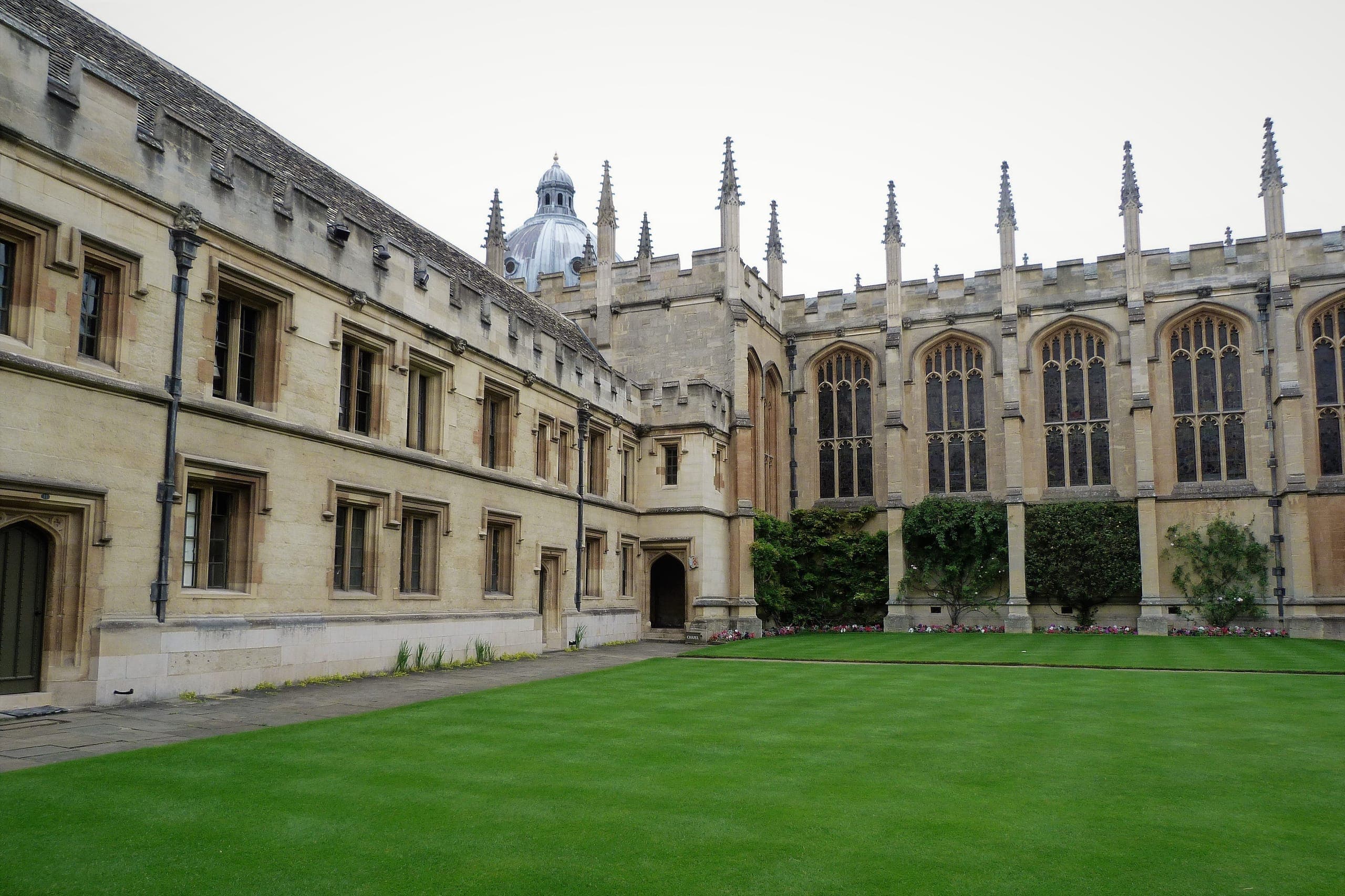
Stone college quadrangle viewed through an archway

Section 12

卒業後のキャリア

Cambridge Geography graduates enter a wide range of destinations rather than a single vocational route. Cambridge Careers identifies manufacturing and utilities, accountancy and audit, consultancy, environment, public sector, policy, research, teaching and education as key sectors, and notes that around 17% of the most recent survey cohort continued to further study.

Discover Uni/Graduate Outcomes data for 2022–23 reports that 89% of Cambridge BA Geography students were in work and/or study 15 months after the course, with 85% of those in known work classed as highly skilled. Treat those percentages as useful but small-sample: the occupation-type data is based on 30 respondents in work.

Section 13

特別な事情について

Cambridge considers applications holistically, including academic record, school reference, personal statement, any written work or assessment where relevant, contextual data, extenuating circumstances and interview performance.

Extenuating circumstances should normally be included in the UCAS reference. Where that is not possible, Cambridge asks for professional evidence to be sent to the relevant College by the stated October deadline for applicants applying by the 15 October UCAS deadline.

There are no specified required subjects for Geography in Cambridge's official course page. Applicants whose school did not offer Geography should use their personal statement and interview preparation to show geographical thinking through related subjects, reading, local observation, fieldwork, data or independent projects.

Cambridge's own subject-background data show most previous Geography entrants had studied Geography, but the course page states there are no subject preferences. This should be framed as admissions context, not a formal requirement.

Watch & Learn

Cambridge Geography 参考動画

学生ブログ・模擬面接・講義体験・入試アドバイス。

Geography at Cambridge

Undergraduate students and staff discuss studying Geography at the University of Cambridge.

Day in the life of a Cambridge geography student

A student-led view of studying Geography at Cambridge.

Geography: More than just colouring in

Cambridge Geography students explain what they study and why the subject is broad and analytical.

Going Places with Geography Part 1

A Royal Geographical Society video introducing progression and careers with Geography.

Introducing: NASA's Earth System Observatory

NASA introduces satellite missions designed to provide data on climate change and Earth systems.

All videos are the property of their respective creators.

Further Reading

Recommended Resources

専門講師が推薦するSupercurricular読書リスト・ウェブサイト・ツール。

  • Cambridge Geography course page by University of Cambridge[Website]Primary source for entry requirements, structure, teaching, assessment, and application notes.
  • Royal Geographical Society school resources by Royal Geographical Society with IBG[Website]Reliable school-level material for geography topics, careers, podcasts, and enrichment.
  • NASA Earth Observatory by NASA[Website]Satellite images and explainers on climate, Earth systems, hazards, and environmental change.
  • Our World in Data by Global Change Data Lab[Website]Charts and datasets useful for Cambridge Geography topics such as development, inequality, energy transitions, emissions, environmental change and dissertation-style data evaluation.
  • Gapminder by Gapminder Foundation[Website]Interactive tools for building a fact-based global-development worldview.
  • QGIS Training Manual by QGIS Documentation[Website]Free structured training for learning GIS and spatial analysis.
  • Esri Going Places with Spatial Analysis by Esri[Course]A practical spatial-analysis course suitable for applicants wanting GIS evidence.

よくあるご質問

There is no central or external pre-registration admissions test for Geography. However, Cambridge's current course page says some Colleges may arrange a College admission assessment with no advance registration, and the current College-assessments page lists Geography only for Hughes Hall, with details provided by the College if relevant.
No university-wide required subject is specified for Geography. Cambridge's course page does not list required or preferred subjects for Geography, although many previous successful applicants have studied Geography.
The verified requirement is A*AA at A Level. Cambridge lists IB guidance as 41–42 points overall with 776 at Higher Level for entry in the relevant cycle.
Current Cambridge guidance and the official Cambridge guidance shows that most applicants have usually 1 or 2 interviews totalling 35 minutes to 1 hour. The exact number, format and location are confirmed by the assessing College in the interview invitation.
No. Cambridge's official course page confirms written work is not required, and Cambridge's course page says applicants will not usually be asked to submit examples of written work.
College choice affects where an application is first assessed and which College community the applicant may join, but it should not be treated as a tactic. Strong applicants who cannot be offered by their original College can be considered by other Colleges through the Winter Pool.
It should show analytical curiosity about both places and processes, not just general interest in the environment. Strong evidence can include reading, field observation, GIS or data work, essays, lectures, podcasts, and reflection on current geographical debates.
Yes. International applicants use the same 15 October UCAS deadline for Cambridge courses, followed by Cambridge's supplementary My Cambridge Application deadline. They should also plan early for English-language evidence, interview logistics, and visa timing.

Geography(Cambridge)出願の専門サポート

専門講師との無料30分相談をご予約ください。

無料相談を予約する