完全入試ガイド

Materials Science at University of Oxford

Oxfordへの当塾生徒の合格率

65%

Oxfordの平均合格率

17%

Materials Science(University of Oxford)出願に必要なすべて:出願要件・面接・典型オファーとOxford卒業生によるインサイダーアドバイス。

最終更新: 2026年5月

主要情報

  • A*AA典型オファー
  • 6:1志願者 / 定員
  • #1UK順位
  • 43定員(年)
  • FJ22UCAS コード

概要

コース概要

Oxford Materials Science is a four-year MEng; the current official course page lists UCAS code FJ22, despite a legacy registry discrepancy. The standard offer is A*AA including Mathematics and Physics, with no written admissions test or written work for 2027 entry.

なぜOxfordでMaterials Scienceを?

{KEY_FACTS_TABLE}

A university lecture hall from the back, students taking notes

Section 01

国際学生の出願

下のマップで自国をクリックすると、出願に必要な情報(受け入れられる資格、要求スコア、英語要件、現地の文脈)が表示されます。

International Applicants

Country-specific admissions requirements

FijiTanzaniaW. SaharaCanadaUnited States of AmericaKazakhstanUzbekistanPapua New GuineaIndonesiaArgentinaChileDem. Rep. CongoSomaliaKenyaSudanChadHaitiDominican Rep.RussiaBahamasFalkland Is.NorwayGreenlandFr. S. Antarctic LandsTimor-LesteSouth AfricaLesothoMexicoUruguayBrazilBoliviaPeruColombiaPanamaCosta RicaNicaraguaHondurasEl SalvadorGuatemalaBelizeVenezuelaGuyanaSurinameFranceEcuadorPuerto RicoJamaicaCubaZimbabweBotswanaNamibiaSenegalMaliMauritaniaBeninNigerNigeriaCameroonTogoGhanaCôte d'IvoireGuineaGuinea-BissauLiberiaSierra LeoneBurkina FasoCentral African Rep.CongoGabonEq. GuineaZambiaMalawiMozambiqueeSwatiniAngolaBurundiIsraelLebanonMadagascarPalestineGambiaTunisiaAlgeriaJordanUnited Arab EmiratesQatarKuwaitIraqOmanVanuatuCambodiaThailandLaosMyanmarVietnamNorth KoreaSouth KoreaMongoliaIndiaBangladeshBhutanNepalPakistanAfghanistanTajikistanKyrgyzstanTurkmenistanIranSyriaArmeniaSwedenBelarusUkrainePolandAustriaHungaryMoldovaRomaniaLithuaniaLatviaEstoniaGermanyBulgariaGreeceTurkeyAlbaniaCroatiaSwitzerlandLuxembourgBelgiumNetherlandsPortugalSpainIrelandNew CaledoniaSolomon Is.New ZealandAustraliaSri LankaChinaTaiwanItalyDenmarkUnited KingdomIcelandAzerbaijanGeorgiaPhilippinesMalaysiaBruneiSloveniaFinlandSlovakiaCzechiaEritreaJapanParaguayYemenSaudi ArabiaAntarcticaN. CyprusCyprusMoroccoEgyptLibyaEthiopiaDjiboutiSomalilandUgandaRwandaBosnia and Herz.MacedoniaSerbiaMontenegroKosovoTrinidad and TobagoS. Sudan

Pick a highlighted country to see the admissions-test, score, and English-language requirements that apply for applicants from that country.

Section 02

出願要件

  • A-LevelA*AA
    Mathematics, One of Physics/Chemistry required.
Admissions test
No pre-registered admissions test for 2027 entry. Oxford retired the legacy written test for this course family — applicants are assessed on UCAS application, predicted grades, personal statement and interview alone.
Interview
Two college interviews of around 25 minutes each. Subject-specific discussion or problem-solving interviews typical of Oxford tutorial teaching. Most interviews are in person at the college; many colleges still offer online interviews for international applicants.

Section 03

出願プロセスと重要日程

YEAR 12

Build the required science profile

Choose and sustain the required subject combination: Mathematics and Physics are essential, and Chemistry is highly desirable. Use this period to strengthen mathematical fluency, physical reasoning and evidence of curiosity about materials.

MAY — AUG 2026

Prepare the UCAS application

UCAS opens for 2027 entry in May, but completed applications cannot be submitted until September. Draft the personal statement, confirm your referee timeline and decide whether to choose a college or make an open application.

1 SEP 2026

UCAS submission window opens

Completed undergraduate applications can be submitted to UCAS from 1 September. Aim to have the form and reference ready well before the October deadline.

15 OCT 2026

Submit UCAS by 18:00 UK time

Oxford Materials Science applications must be submitted through UCAS by the Oxford/Cambridge deadline. There is no Materials Science admissions-test booking row for this cycle because the current official course page says no written admissions test is required.

LATE NOV — EARLY DEC 2026

Watch for shortlisting communication

Oxford normally sends interview invitation or rejection communication between mid-November and early December, depending on the course timetable. Shortlisted applicants may receive relatively short notice.

DEC 2026

Attend online Materials Science interviews

Shortlisted Materials Science applicants should expect two online, tutorial-style academic interviews, normally with two different colleges. The exact 2027-entry subject timetable should be checked when Oxford publishes it.

12 JAN 2027

Receive Oxford decision

Shortlisted candidates for 2027 entry are informed of the outcome through UCAS on 12 January 2027, with colleges following up directly later that day.

MAY — JUN 2027

Reply to offers through UCAS

Your UCAS reply deadline depends on when all universities have made decisions. For applicants who receive all decisions by 12 May 2027, UCAS lists 2 June 2027 as the decline-by-default deadline.

AUG 2027

Meet offer conditions and confirm place

Offer-holders completing school qualifications should monitor UCAS and Oxford communications when results are released. The exact 2027 JCQ/A-level results date was not verified in the official sources checked for this slice.

Section 04

入試テスト

Student working through problems at a desk with timed papers

Materials Science(University of Oxford)の2027年度入試では、出願者に書面の入試テストは課されません。出願は推薦書・成績・パーソナルステートメント・提出物・面接で評価されます。

Always verify on the official Oxford admissions tests page.

Section 05

面接:当日の流れと対策

Invitation → Decision: the interview timeline

Interview Invitation

Late Nov

Arrival to Interview

Early Dec

Technical Question

Mid Dec

Decision

Early Jan

Question Types You’ll See

Unseen physical-science or engineering problem to reason through aloudMathematical modelling, estimation or graph-sketching taskDiscussion of a material, object, diagram or data pattern and its propertiesQuestions probing motivation for Materials Science and relevant super-curricular explorationFollow-up prompts that test how the applicant adapts when given hints or new information

Oxford Materials Science interviews are tutorial-style physical-science problem-solving discussions. They test logical reasoning on unfamiliar problems, mathematical ability, links between Materials Science, Physics, Chemistry and Mathematics, and the ability to think aloud when given prompts.

In reality, preparation should focus less on polished speeches and more on explaining your reasoning under pressure. Practise sketching graphs, setting up simple models, estimating quantities, and correcting your approach after a hint.

The interview may include unseen physical-science or engineering problems, mathematical modelling, estimation, graph-sketching, discussion of a material or data pattern, and follow-up prompts. It helps to practise saying exactly what assumption you are making before you calculate.

無料のMaterials Science面接練習問題バンクで本番さながらの問題を練習しましょう。

無料練習問題
Two people in academic discussion across a table

Section 06

合否決定のしくみ

Oxford Materials Science decisions should be presented as holistic rather than formulaic.

The main evidence comes from academic potential in mathematics and physical science, shown through prior attainment and through the two interviews. The decision criteria also include educational achievement, subject interest, motivation, communication, the UCAS application, the personal statement and the academic reference.

Contextual information and special circumstances should be treated as factors applied across the assessment rather than as a separate mechanical score. We recommend reading any percentage bars on the page as a guide to emphasis, not as Oxford’s official marking formula.

Our recommendation · weighting of admission factors

0102030405046%
Interview
31%
Predicted grades
15%
Personal statement
8%
Contextual factors
% of decisionFactor

Oxbridge Mentors recommendation, drawn from observed offer patterns. University of Oxford does not publish official weightings — exact balance varies by college, course and year.

Section 07

Personal Statement のコツ

Handwritten notes and a laptop open to a draft document

A strong Materials Science personal statement should show that you understand the subject sits between structure, properties, processing and performance. We recommend choosing two or three specific examples rather than trying to cover every material you have ever read about.

Use the statement to make your thinking visible. A paragraph on why a cracked bicycle component, a battery cathode or a superconducting material interested you is more useful than a generic claim that you enjoy science.

Reflection matters more than volume. It helps to show what changed in your understanding: a model that failed, a graph you misread, a property trade-off you had not expected, or a link you made between school Physics and real materials.

専門家による一行一行の解説付き完全例文を見る。

Materials Science PS例文

Section 08

プロジェクト

  1. 01正当性
  2. 02プロジェクト概要
  3. 03実施内容
  4. 04困難
  5. 05解決策
  6. 06振り返り

Projects are useful because they give you evidence to discuss in the personal statement and at interview. They should not be over-polished; the most useful projects usually have a clear question, a method, a result, and something that went wrong.

  • Materials failure case study: Choose a failed object such as a cracked bicycle part, corroded fitting, snapped polymer item or overheated component. Research the material, likely processing route, stress environment and failure mode, then write a short investigation connecting microstructure, properties and design decisions.
  • Battery materials comparison: Compare two or three battery material systems, such as lithium iron phosphate, nickel manganese cobalt oxides and solid-state electrolytes. Focus on structure-property links, safety, supply-chain constraints, energy density and what trade-offs engineers must manage.
  • Sustainable materials audit: Pick one product category such as packaging, concrete, aerospace composites or medical implants. Compare candidate materials using mechanical performance, embodied carbon, recyclability, cost and manufacturing feasibility.
Open books, a notebook, and a coffee on a wooden desk

Section 08

その他のサプリキュラム

Other supercurricular work should support your academic case rather than decorate it. Use each activity to sharpen one skill: physical reasoning, mathematical fluency, experimental care, or scientific communication.

These are support, not substitute.

  • Physics and mathematics problem-solving:

    Use Olympiad-style physics and UKMT/ BMO problems to practise multi-step reasoning under unfamiliar conditions, then keep a log of methods learned and mistakes corrected.

  • Reading with reflection:

    Read accessible materials science books or articles and write brief reflections on one structure-property-processing idea from each source rather than only summarising the content.

  • Practical investigation:

    Use a school lab project, CREST project, EPQ or safe home experiment to explore variables, uncertainty and measurement, especially in strength, conductivity, corrosion, crystallisation or diffusion.

  • Lectures and talks:

    Watch Royal Institution, Oxford Sparks, university or professional-society lectures, then prepare two or three questions you would ask the speaker.

  • Computational exploration:

    Use Python, spreadsheets or online crystal-structure tools to model a simple relationship such as diffusion with temperature, stress-strain behaviour, lattice packing or phase stability.

  • Industrial and societal awareness:

    Track one materials-intensive sector such as semiconductors, nuclear fusion, aerospace, batteries, biomaterials or green construction, and connect technical choices to cost, manufacturing and sustainability constraints.

Section 08

コンペティション

Competitions are not required. They can be useful because they stretch your physics and mathematics beyond routine school questions.

  1. British Physics Olympiad Round 1 tests Advanced physics reasoning, quantitative modelling and unfamiliar problem-solving. Prepare by: Work through past BPhO papers slowly first, then under timed conditions, focusing on clear physical assumptions and units.
  2. Physics Challenge tests Physics problem-solving for younger sixth-form or pre-A-level students. Prepare by: Build fluency in mechanics, electricity, waves and materials-linked physics using past challenge problems.
  3. UK Senior Mathematical Challenge tests Mathematical fluency, pattern recognition and concise problem-solving. Prepare by: Practise past UKMT Senior Mathematical Challenge papers and review every missed problem for method, not just answer.
  4. British Mathematical Olympiad Round 1 tests Proof-based and extended mathematical reasoning. Prepare by: Use BMO Round 1 past papers to develop rigorous written solutions, especially in algebra, geometry and combinatorics.
  5. Senior Physics Challenge tests Year 12/AS-level physics reasoning with problems that reward conceptual clarity and careful calculation; BPhO notes that older papers used the AS Physics Challenge name. Prepare by: Practise the official Senior Physics Challenge papers and write out assumptions, diagrams and units at each stage.

None are required; one or two done well beats five half-attempted.

Section 09

コース内容

  1. Year

    01 / 04

    1

    Foundations and First University Examinations

    Physical foundations, structure and processing

    The first year establishes the physics, mechanics, processing, mathematics and computing base for the degree. Teaching combines lectures, small-group tutorials/classes and practical work, ending with First University examinations.

    Shared foundation in physics, chemistry, mathematics, computing and practical laboratory skills.

  2. Year

    02 / 04

    2

    Core materials science, engineering and entrepreneurship

    Properties, processing, communication and industrial context

    Year 2 deepens the core science and engineering of materials through lifecycle, electronic, mechanical, structural and thermodynamic topics. It also adds practical work, entrepreneurship, industrial visits/talks and communication skills before formal Finals assessment begins in Year 3.

    Entrepreneurship and industrial context are built into the course before third-year options.

  3. Year

    03 / 04

    3

    Options, modelling and Final University Examinations Part I

    Options and team design

    Year 3 begins with a two-week team design project and then moves into option-course teaching and specialist modelling or characterisation work. Students can also transfer at this stage to a three-year BA in Materials Science, but the BA is not accredited.

    Finals Part I and options create the main specialist taught phase.

  4. Year

    04 / 04

    4

    Full-time research project and Final University Examinations Part II

    Eight-month research project across extended terms

    The final year is dominated by a supervised full-time research project spanning three extended terms. Students join a research team in Oxford or, occasionally, an overseas university or industrial laboratory and are assessed through a dissertation and oral examination.

    The eight-month full-time research project is a distinctive feature of the Oxford MEng.

Section 10

Materials Scienceの知識を深める

Start with the official Oxford Materials undergraduate reading list because it is the department’s own applicant-facing starting point. The reading-list links for Stuff Matters, The New Science of Strong Materials and A Materials Science Guide to Superconductors and How to Make Them Super point to Oxford's department reading list rather than individual book pages.

For accessible reading, * Stuff Matters * connects everyday materials to structure and technology, while * The New Science of Strong Materials * is a stronger route into strength, fracture and load. For applicants ready to stretch, * A Materials Science Guide to Superconductors and How to Make Them Super * links physics, crystal structure and functional materials, and Concepts of Materials Science is the more technical option for applicants who want to move beyond popular science.

For video learning, use the embedded video cards alongside The Royal Institution, Oxford Sparks and Taylor Sparks, then turn each lecture into two or three points you could explain under interview conditions.

For wider scientific literacy, The Naked Scientists Podcast, Instant Genius and the Nature Podcast are useful ways to practise turning current research into clear explanations. For structured online exploration, Materials Science: 10 Things Every Engineer Should Know introduces properties, manufacturing and applications, while Materials Project lets you explore crystal structures and computed properties.

A study planner, highlighters and a stack of revision cards

Section 11

カレッジ選択と再振り分け

39 colleges offer this subject. Around one third of Oxford applicants are reallocated each year under Oxford's college allocation process; the Materials department also reallocates applicants to balance interview ratios across colleges. of places come through the pool.

For Materials Science, college choice can affect where an applicant lives, who interviews them, and the community they join.

It should not be treated as a way to game admissions. The Department of Materials uses a departmental approach to shortlisting and interviewing, and candidates who are invited are interviewed by two colleges.

Oxford says around one third of Oxford applicants are reallocated each year under its college allocation process, and the Materials department may reallocate applicants to balance interview ratios across colleges.

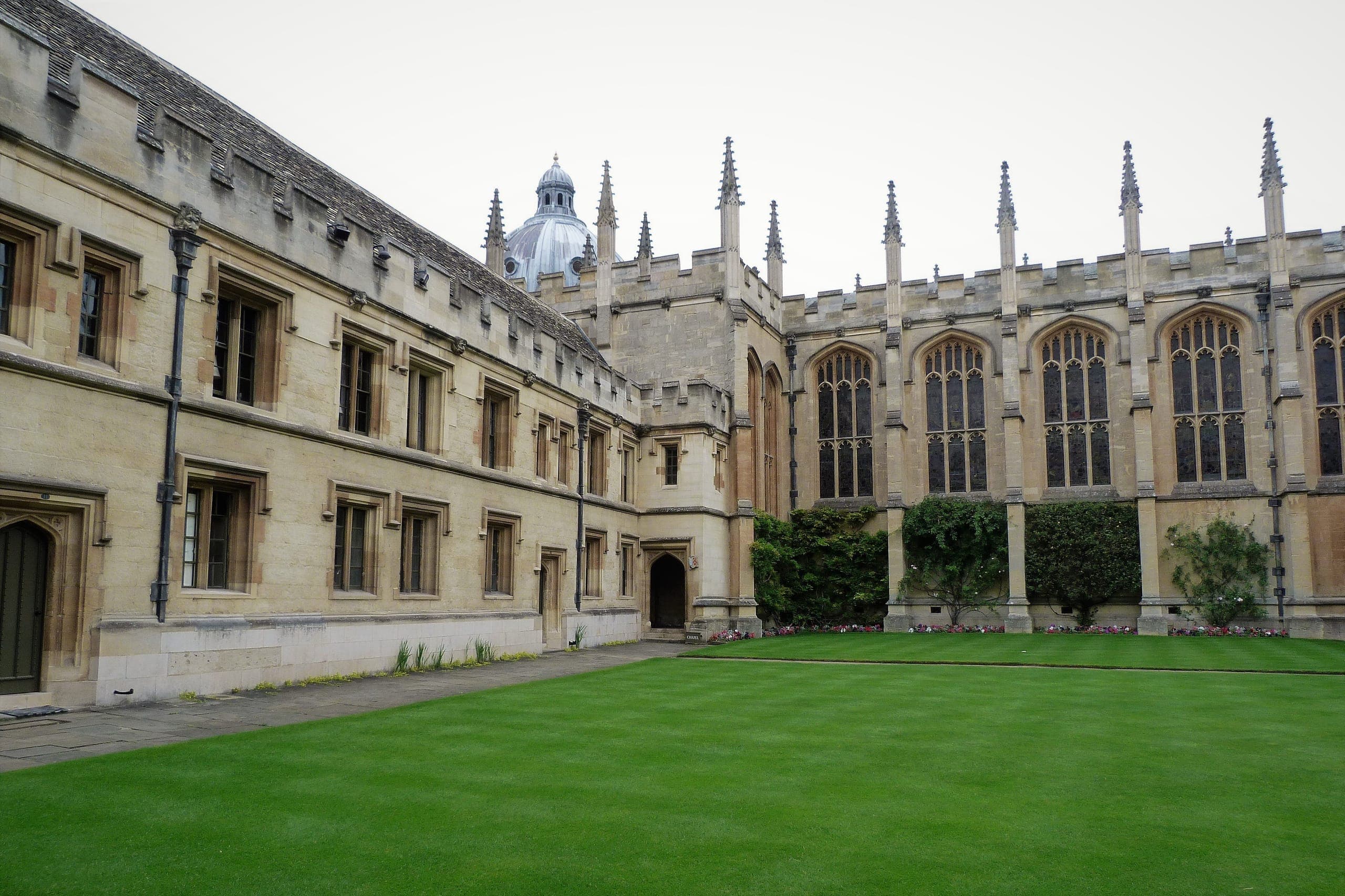
Stone college quadrangle viewed through an archway

Section 12

卒業後のキャリア

Section 13

特別な事情について

Oxford considers grades and attainment in context, including school and neighbourhood information, care experience, free school meal indicators and other widening-participation data where available. For Materials Science, departmental admissions materials state that UCAS grades, contextual information and mitigating circumstances are considered during selection.

Oxford Materials tutors recognise that many school students have not studied Materials Science as a named subject. Applicants are not expected to arrive with specialist undergraduate-level knowledge, but they should show strong Mathematics and Physics foundations and curiosity about how materials behave.

If your school limited access to Chemistry, Further Mathematics or relevant enrichment, explain the constraint through the UCAS reference or extenuating-circumstances route rather than relying on the personal statement alone. Evidence of curiosity, sustained problem-solving and reasoning from physical-science principles is likely to be more useful than a long list of unrelated activities.

Watch & Learn

Oxford Materials Science 参考動画

学生ブログ・模擬面接・講義体験・入試アドバイス。

Strange Materials with Mark Miodownik

A Royal Institution lecture showing how everyday materials can be used to explore core materials-science ideas.

Materials for nuclear fusion: how do you confine a sun to a box?

An Oxford Sparks video connecting materials performance to extreme engineering environments.

What is Materials Science?

A concise introduction to what materials scientists study and why the discipline connects physics, chemistry and engineering.

Understanding Crystal Structures: Symmetry and Lattices

A useful stretch video for applicants beginning to connect atomic arrangement with material properties.

Materials Characterisation Techniques | Dalton Seminar Series

A more advanced research-facing talk introducing how scientists study defects and properties in materials.

All videos are the property of their respective creators.

Further Reading

Recommended Resources

専門講師が推薦するSupercurricular読書リスト・ウェブサイト・ツール。

よくあるご質問

No. Oxford's current course page and Department of Materials admissions policy state that there is no written test for Materials Science.
No. The current Oxford course page states that no written work is required, and no portfolio requirement is listed.
Oxford requires Mathematics and Physics. The A-level offer is A*AA including Mathematics and Physics, with the A* in Mathematics, Physics or Chemistry. Chemistry at A-level is listed as highly desirable, and Further Mathematics can be helpful but is not required.
Shortlisted applicants should expect online interviews in December. Materials Science applicants are normally interviewed by two colleges, and interviews focus on reasoning from Mathematics, Physics and related science rather than testing memorised Materials Science content.
Yes. Oxford explicitly recognises that most applicants will not have studied Materials Science as a school subject. Applicants should instead show strong foundations in Mathematics and Physics, curiosity about materials, and the ability to reason through unfamiliar scientific problems.
College choice affects the applicant's possible living and tutorial community, but it should not be treated as an admissions strategy. The Materials department operates a subject-wide selection process and may reallocate applicants to balance interview numbers.
In the 2025 Department of Materials feedback statistics, there were 237 applications, 127 shortlisted applicants and 50 offers, giving a listed success rate of 21%. The course page lists an average intake of 43.
Oxford describes destinations including manufacturing, research and development, management, finance, consulting, IT and further research degrees. Applicants should not present the course as training for only one sector; it is broad and quantitative.

Materials Science(Oxford)出願の専門サポート

専門講師との無料30分相談をご予約ください。

無料相談を予約する